Chocolate can feel like a cozy dessert—but if you’re caffeine-sensitive, eating it late can raise a real question: does chocolate contain caffeine, and how much? The short answer is yes (most of the time), because cacao beans naturally contain caffeine. The longer answer is that the amount depends on cocoa solids, cacao percentage, and serving size—which is why one person can eat a few squares and sleep fine while another feels unexpectedly “wired.”
Does Chocolate Have Caffeine?
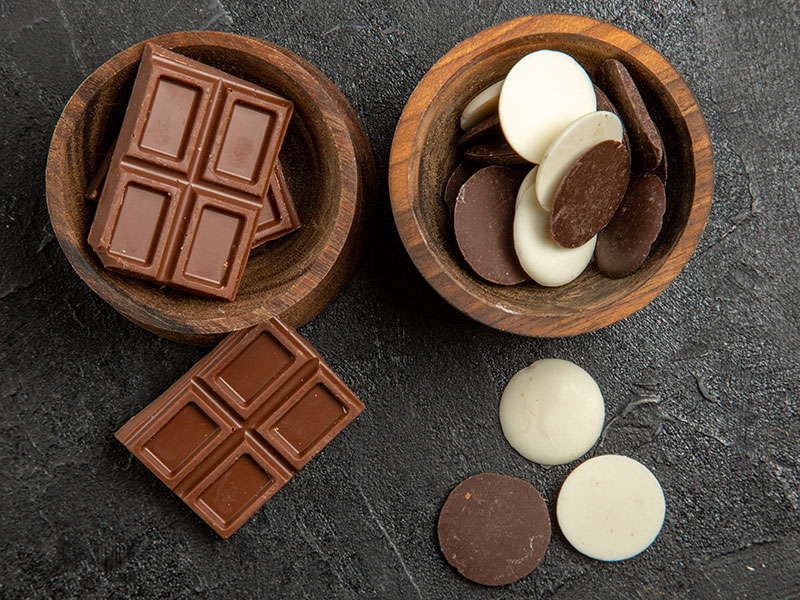
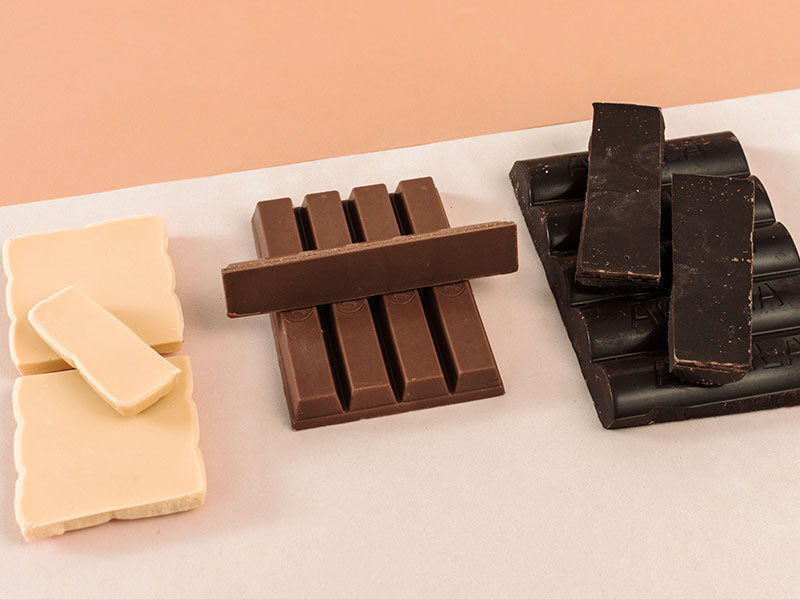
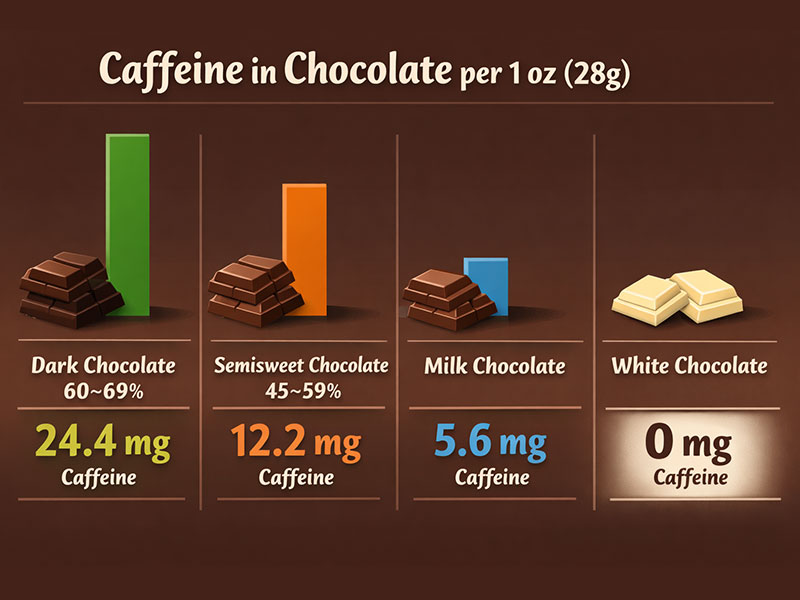
Yes. Most chocolate contains caffeine because cacao naturally contains it. Dark chocolate usually has more caffeine than milk chocolate since it contains more cocoa solids. Typical amounts range from ~13–24 mg per 1 oz (28 g) of dark chocolate, while milk chocolate is often lower, and white chocolate is usually caffeine-free because it typically contains cocoa butter but little to no cocoa solids.
Caffeine in Chocolate (mg) — Quick Table by Type
Use the table below as a practical reference point. It standardizes most entries to 1 oz (28 g) so you can compare quickly.Cacao %, cocoa solids, and portion size can change your real number.
| Chocolate type | Serving | Approx caffeine (mg) | Notes |
|---|---|---|---|
| Dark chocolate (60–69% cacao solids) | 1 oz (28 g) | ~24 | Higher cocoa solids → typically more caffeine |
| Dark chocolate (general entry) | 1 oz (28 g) | ~13 | “Dark” varies by brand/formulation |
| Milk chocolate (example: M&M’s Milk Chocolate Candies) | 1 pack (1.69 oz) | ~7 | Lower cocoa solids than dark |
| Chocolate milk | 1 cup | ~2 | Recipe differences matter |
Why Chocolate Has Caffeine
Caffeine in chocolate comes from cocoa solids, the part of the cacao bean that becomes cocoa powder and gives chocolate much of its “chocolatey” flavor. When a chocolate label says 60–69% cacao, that typically means more cocoa solids in the recipe—so you often see higher caffeine than in milk chocolate, which includes more milk and sugar and less cocoa content.
That’s the key idea to remember: more cocoa solids generally means more caffeine. But “generally” matters—because labels and products aren’t standardized. Two “dark chocolate” bars can differ in cacao %, portion size, and processing, so their caffeine can vary even if the packaging looks similar.
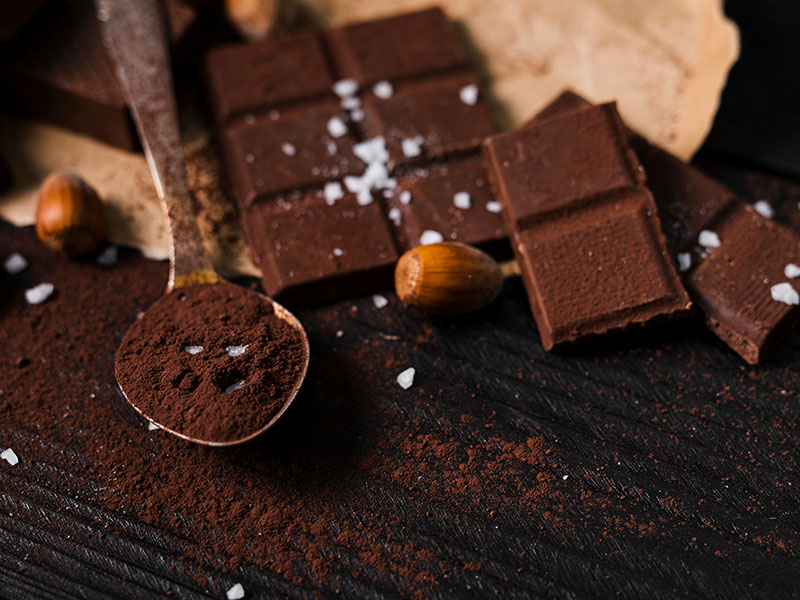
Does Dark Chocolate Have Caffeine?
Yes—dark chocolate contains caffeine, and it’s usually the highest-caffeine chocolate category most people eat. A helpful reference point from USDA SR Legacy data is that dark chocolate (60–69% cacao solids) has about 24 mg of caffeine per 1 oz (28 g).
Another “dark chocolate” entry in the same dataset is about 13 mg per 1 oz, which highlights how much the category can vary.
What does that mean in real life?
Most people don’t weigh chocolate—they eat “a few squares.” Many bars are portioned so that 1–2 squares might be 8–15 g, while half a bar could be 40–50 g. If your dark chocolate is roughly 24 mg per 28 g, then:
- 10 g (about a small couple of squares) is roughly 9 mg
- 20 g is roughly 17 mg
- 40 g can be roughly 34 mg
That’s still far below a typical cup of coffee—but if you’re sensitive or it’s close to bedtime, it can be enough to notice.
Does Milk Chocolate Have Caffeine?
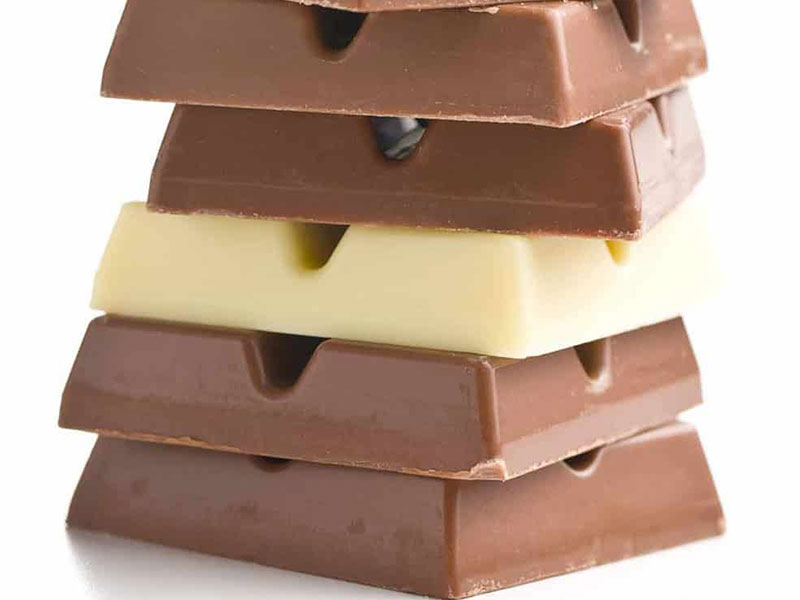
Yes, milk chocolate usually contains caffeine—just less than dark chocolate. Because milk chocolate typically has less cocoa solids, you’re generally getting a smaller caffeine dose per bite.
A concrete example: USDA’s SR Legacy list shows M&M’s Milk Chocolate Candies at about 7 mg of caffeine per 1.69 oz package.
That’s not much for most adults, but it can matter for people who are caffeine-sensitive, children, or anyone eating multiple servings (or pairing chocolate with coffee/tea).
What About White Chocolate?
White chocolate is the easiest one for caffeine-avoidance: it’s usually caffeine-free because it’s typically made from cocoa butter (fat) rather than cocoa solids (where caffeine is concentrated). That said, “white chocolate” products flavored with coffee, espresso, matcha, or tea can contain caffeine—so if you’re sensitive, it’s still smart to check labels.

Hot Chocolate, Cocoa, and Chocolate Milk — How Much Caffeine?
This is where the confusion happens, because “chocolate drinks” aren’t one product—they’re a whole family of recipes.
Chocolate milk often contains only a small amount of caffeine. A USDA reference example lists about 2 mg per cup.
But different brands use different cocoa/syrup amounts, so the range can vary.
Hot chocolate / cocoa can vary even more. A packet mix may be very low, while café-style hot cocoa can be higher if it uses more cocoa or if it’s made “mocha-style” with espresso. If you’re ordering out and sleep matters to you, the fastest way to know is to check the café’s nutrition info (or ask if it contains espresso).

Why Caffeine in Chocolate Varies So Much
If you’ve ever wondered why one chocolate bar feels stronger than another, it usually comes down to four factors:
- Cacao percentage and cocoa solids
Higher cocoa solids usually = higher caffeine. - Serving size
A “serving” on the wrapper might be 10 g, but the bar might be 80–100 g. If you eat the whole bar, your caffeine scales up. - Added ingredients
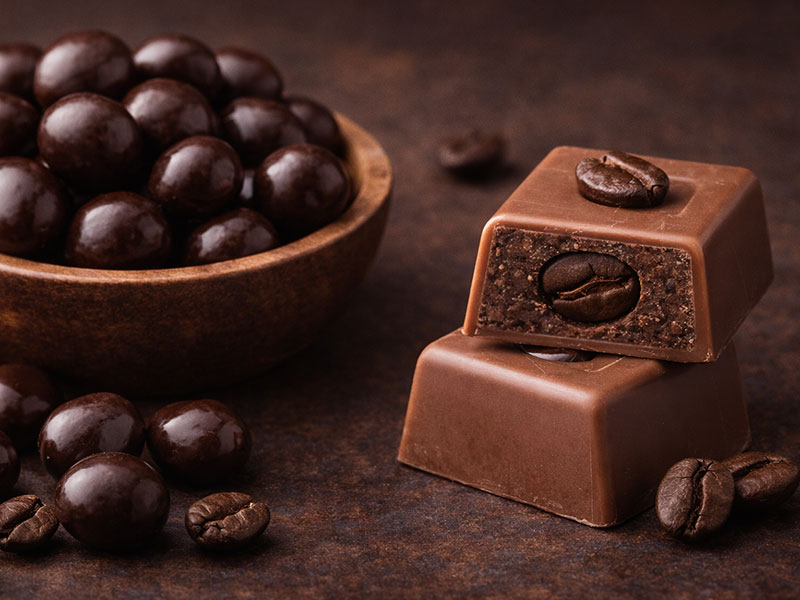
Some chocolate products include coffee, espresso powder, matcha, guarana, or “energy” blends—these can raise caffeine quickly. - Product form
Chips, baking chocolate, coated snacks, and desserts can deliver different cocoa loads per bite.
That’s why a single “mg number” for all chocolate isn’t realistic—and why the next section (calculator) earns backlinks and keeps readers on the page.

Simple Calculator — Estimate Caffeine in Your Chocolate
You can estimate your caffeine intake with one simple conversion.
1. Find how many grams you ate
Look at the nutrition label for serving size in grams (g), and estimate your total grams eaten.
2. Choose a reference value
Use an anchor that matches your chocolate type, such as:
- Dark chocolate (60–69% cacao solids): 24 mg per 28 g
- Dark chocolate (general entry): 13 mg per 28 g
3. Convert to mg per gram
- mg per gram = (mg per 28 g) ÷ 28
- 24 ÷ 28 ≈ 0.86 mg/g
- 13 ÷ 28 ≈ 0.46 mg/g
4. Multiply by grams eaten
- Estimated caffeine (mg) = (mg/g) × grams eaten
Example: You ate 30 g of dark chocolate (60–69%).
0.86 mg/g × 30 g ≈ 26 mg caffeine.
Will Chocolate Keep You Awake?
Sometimes. Two people can eat the same chocolate and feel very different, because caffeine sensitivity and metabolism vary widely. The average caffeine half-life in healthy adults is about 5 hours (with a broad range), meaning a meaningful amount can still be active hours later.
Chocolate can also feel stimulating even when caffeine is modest because it contains theobromine, a different compound in cacao that can have stimulant-like effects. To illustrate (without over-generalizing), FDA provides a calculation example using semisweet chocolate chips at 136 mg theobromine per ounce in that specific example.
Practical sleep guidance (non-medical)
- If you’re sensitive, treat dark chocolate as “late-day caffeine.”
- Consider avoiding dark chocolate within ~6 hours of bedtime, especially larger portions.
- If you want a night dessert, a smaller portion of milk chocolate—or white chocolate—often affects sleep less.

How Much Caffeine Is Too Much?
For most adults, the FDA cites 400 mg per day as an amount “not generally associated with negative effects.”
Chocolate usually contributes far less than coffee, but it adds up when combined with other sources (coffee, tea, soda, energy drinks, pre-workout, certain medications).
Pregnancy: ACOG guidance commonly recommends limiting caffeine to less than 200 mg/day.
If you have specific health concerns, it’s best to ask a clinician for personal guidance.
Key Takeaways
Chocolate usually contains caffeine because cacao naturally contains it. Dark chocolate generally has more caffeine than milk chocolate, largely due to higher cocoa solids, while white chocolate is usually caffeine-free because it contains cocoa butter rather than cocoa solids. The biggest “hidden” factor is serving size—so if you want a reliable estimate, use the simple grams-based calculator above.
FAQ (People Also Ask targets)
1. Does chocolate have caffeine?
Yes—most chocolate contains caffeine because cacao naturally contains it. Dark chocolate usually has more than milk chocolate.
2. Does dark chocolate have caffeine?
Yes. A reference point is ~24 mg per 1 oz (28 g) for dark chocolate (60–69% cacao solids), though products vary.
3. Does milk chocolate have caffeine?
Yes, usually a small amount. Example: M&M’s Milk Chocolate Candies list ~7 mg per 1.69 oz package.
4. How much caffeine is in 1 oz of dark chocolate?
Common reference anchors are ~13–24 mg per 1 oz depending on the dark-chocolate entry and cacao solids.
5. How much caffeine is in a chocolate bar?
It depends on the bar’s total grams and cacao %. Use: (mg per 28 g ÷ 28) × grams eaten.

6. Does white chocolate have caffeine?
Usually no, because it typically contains cocoa butter and little/no cocoa solids. (Check labels if it’s coffee/tea flavored.)
7. Does hot chocolate have caffeine?
Sometimes. Mixes and café recipes vary widely, and mocha-style drinks can include espresso.
8. Will chocolate keep you up at night?
It can—especially dark chocolate or large portions close to bedtime. Caffeine half-life averages ~5 hours, but varies by person.
9. Is theobromine the same as caffeine?
No—different compounds. Chocolate contains both; theobromine can still feel stimulating for some people.
10. How can I estimate caffeine in my chocolate?
Convert mg per 28 g into mg per gram, then multiply by grams eaten (steps above).
Build Next-Best-Sellers Faster with Our OEM/ODM Team
MPS is a factory-direct confectionery manufacturer serving importers, distributors, wholesalers, and private-label brands worldwide. From product development and compliant production to export-ready packaging, we help you launch and scale best-selling candy lines with stable capacity, consistent quality, and reliable lead times. OEM/ODM is available for flavors, shapes, formulas, and retail-ready packaging.