Importers rarely build a profitable candy business around only one product forever.
A distributor may need gummies for supermarkets, lollipops for convenience stores, marshmallows for seasonal programs and several novelty candies for specialty retailers.
A brand may want three products under one private label range.
A wholesaler may already purchase products from several Chinese suppliers and want to ship them together.
This creates a practical sourcing question:
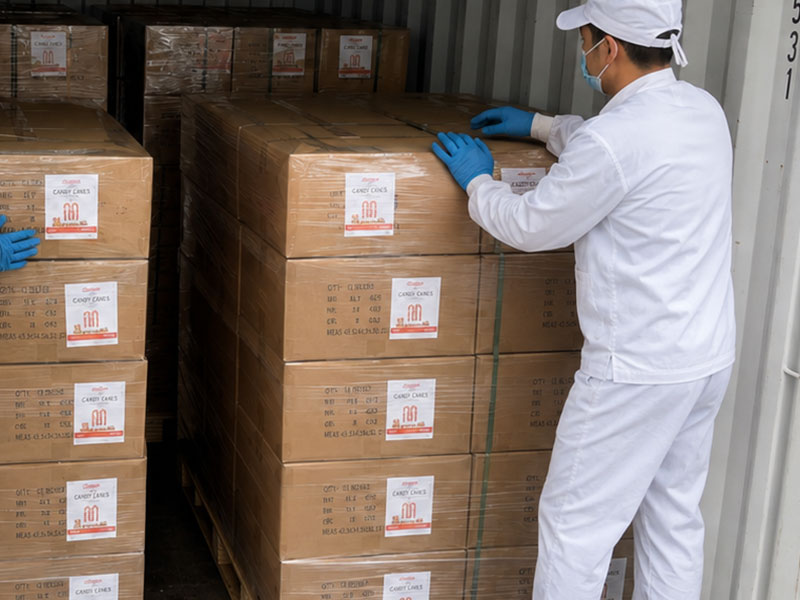
Can different candy products be combined in one container instead of buying a full container of every SKU?
In many cases, yes.
But a mixed candy container is not simply a matter of choosing several products until the container looks full.
Each product still needs to meet its applicable production MOQ. Different packages use container space differently. Some products are much heavier than others. Heat-sensitive confectionery may change the shipping requirement for the entire load. Products from different factories may also have different production schedules.
A successful mixed-container program therefore requires two types of planning at the same time:
production planning and container planning.
When those two are separated clearly, importers can build a broader assortment without creating an inefficient sourcing project.
A Mixed Container Does Not Mean Ignoring Product MOQ
This is the first point buyers need to understand.
Suppose an importer plans to purchase one full container of candy and wants ten different SKUs.
The buyer may think:
The total order is already a full container, so every product should be possible.
But factories do not manufacture “one container.”
They manufacture individual products.
A strawberry gummy has its own production run.
A blue raspberry gummy may require another.
A lollipop is produced on a different line.
A marshmallow may come from a different specialized facility entirely.
That means every selected product still has to reach a commercially workable production quantity before container consolidation becomes relevant.
For many candy products, a typical MOQ may be approximately 2–4 metric tons per flavor, depending on the formula, shape, production process and packaging requirements.
However, this is not a universal rule.
Piece-counted, individually wrapped, molded or highly customized products may instead use MOQ calculations based on pieces, packaging quantity or production batch.
The correct sequence is therefore:
First confirm whether each product can be produced. Then decide how the qualifying products should share the container.
This distinction prevents one of the most common misunderstandings in mixed-SKU candy sourcing.

Core SKUs and Test SKUs Should Not Be Treated Equally
In most commercial assortments, not every product has the same importance.
Some SKUs are expected to generate repeat volume.
Others provide variety.
Some are seasonal.
Others may be new concepts that the buyer wants to introduce carefully.
That difference should influence how the container is allocated.
A useful way to think about a mixed candy shipment is:
| SKU Role | Commercial Purpose | Container Planning Logic |
|---|---|---|
| Core SKU | Expected to generate regular repeat sales | Receives a larger share of purchasing volume |
| Supporting SKU | Adds assortment breadth | Moderate volume based on channel demand |
| Seasonal SKU | Supports a defined selling period | Quantity linked to expected seasonal sell-through |
| New Line Extension | Expands an established range | Added when its MOQ and expected demand make commercial sense |
| Retail-Exclusive / Private Label SKU | Developed for a specific customer or channel | Planned around retail commitment and packaging requirements |
This approach is more useful than trying to divide the container evenly.
Five products do not automatically need 20% of the space each.
A buyer should allocate volume according to expected sales, MOQ and product economics.
Weight and Container Space Are Not the Same Thing
Candy is often purchased by weight, but containers are also limited by physical space.
These two measurements do not always move together.
A dense bulk hard candy may provide substantial weight in a relatively compact carton.
Marshmallows occupy much more volume for the same weight.
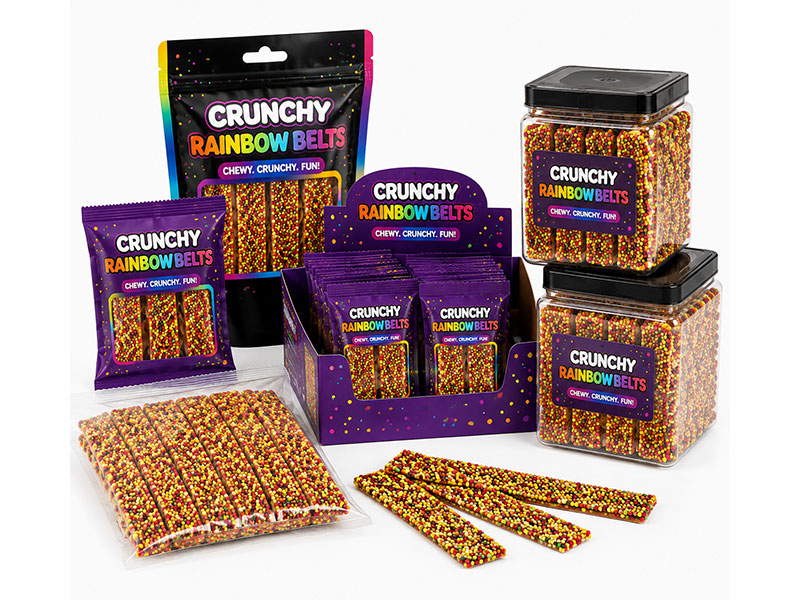
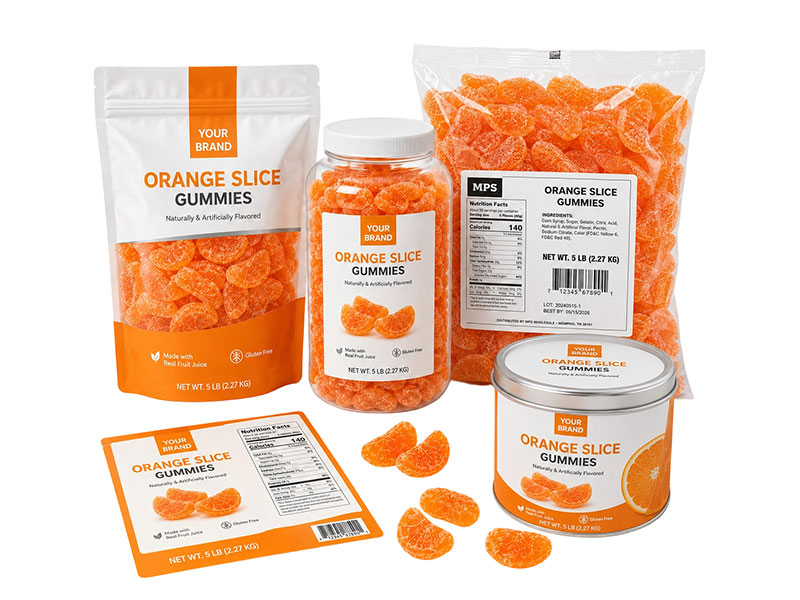
Rigid jars generally use more space than flexible pouches.
Display boxes can create additional carton volume compared with simple bulk packing.
This means a buyer cannot plan a mixed container using metric tons alone.
Two orders with the same total weight may require very different amounts of container space.
In practice, carton dimensions and total cubic volume become increasingly important once the product mix is known.
This is why packaging decisions can significantly influence freight efficiency.
Packaging Can Change the Entire Loading Plan
Imagine the same candy sold in two formats.
The first uses a flexible stand-up pouch.
The second uses a rigid plastic jar.
The product weight may be similar, but the shipping profile is not.
Jars can create more empty space between units, use larger cartons and reduce the amount of saleable product that fits into the same container volume.
This does not mean jars are a poor packaging choice.
They may offer stronger shelf visibility or suit a particular retail channel.
It simply means packaging has a logistics cost as well as a design cost.
The same applies to display boxes.
A display-ready carton can be valuable for convenience stores because the retailer can place it directly on the shelf or counter.
But the box dimensions also influence master-carton size and container utilization.
For mixed-container purchasing, packaging should therefore be discussed before the loading plan is finalized.
A Mixed Container Is a Commercial Assortment, Not a Sample Box
There is an important difference between variety and fragmentation.
A container with four or five well-planned products can create a strong assortment.
A container with twenty very small SKUs may create operational problems.
Every additional SKU can mean another product specification, flavor, packaging material, carton mark, production schedule and inventory position after arrival.
Retailers also need enough stock behind each SKU to sell it consistently.
If a distributor launches too many items with shallow inventory, the strongest products may sell out quickly while weaker products remain in stock.
The objective of mixed-container purchasing should therefore not be:
How many SKUs can we squeeze into one shipment?
It should be:
What is the strongest assortment we can build while keeping every SKU commercially viable?
That difference matters enormously for repeat business.
MOQ Should Help Shape the Assortment
MOQ can actually improve mixed-container planning.
Suppose a buyer initially wants eight gummy flavors.
After reviewing the production requirements and expected demand, the buyer realizes that three flavors have much stronger sales potential in the target market.
Instead of spreading the order across eight low-volume variants, the first container might focus on those three.
The remaining space can then be used for another candy category with a different retail role.
This may create a more balanced commercial assortment than forcing eight similar flavors into the same shipment.
MOQ therefore does not need to be treated only as a restriction.
It can help buyers identify which products deserve real commercial commitment.
Mixing Different Candy Categories Can Reduce Assortment Risk
A container built entirely around one narrow product idea can work very well when demand is established.
But some distributors serve multiple customer types.
For them, a mixed-category container can spread commercial exposure across several parts of the confectionery market.
For example, gummies may serve one customer group while lollipops or hard candies serve another.
Chewy candy may create another price point.
A novelty product may give the sales team something new to present.
The result can be a more useful B2B sales portfolio than a container containing many minor variations of the same item.
However, this only works when the products fit the buyer’s real customer base.
Variety by itself does not reduce risk.
Relevant variety does.
Private Label Makes Mixed Containers More Strategic
Mixed-container planning becomes especially interesting for private label programs.
A brand does not always need to launch ten products at once.
It may begin with a small, coherent family.
For example, three products might share the same visual system while serving different consumer occasions.
The packaging can create brand consistency even when the candy formats differ.
A gummy, chewy candy and lollipop can all belong to one recognizable range if the branding, flavor direction and positioning are coordinated properly.
This allows a buyer to use one container not merely as transportation, but as the physical launch of a product portfolio.
The key is to avoid excessive customization across every SKU.
If every product requires its own mold, formula, flavor system and completely different packaging structure, complexity rises quickly.
A stronger first program may combine established production formats with thoughtful branding and selected product differentiation.
A Mixed Container Can Include Goods from Other Chinese Suppliers
Some importers already purchase other food products, packaging materials or complementary goods from China.
In suitable situations, those goods may be consolidated into the same shipment.
This can be particularly useful when the MPS order does not occupy the complete planned container or when the buyer has several qualified Chinese suppliers feeding the same destination.
However, multi-supplier consolidation requires more coordination than combining several MPS products.
Production schedules need to align.
Cargo must arrive at the agreed loading or consolidation point in time.
Carton dimensions and weights need to be confirmed.
Shipping marks and documentation need to be consistent with the final export plan.
One late supplier can affect the loading schedule for everyone.
For this reason, consolidation should be planned from the beginning rather than requested only after every supplier has finished production.
Production Timing Can Become the Hidden Bottleneck
Consider a container involving four candy products.
Product A finishes first.
Product B follows three days later.
Product C requires custom packaging and finishes another week later.
Product D encounters an artwork delay.
Even though three products are ready, the container may still need to wait for the final SKU.
This is one reason the most customized product often becomes the timing driver for a mixed shipment.
A buyer should therefore look at the production schedule as a complete program rather than checking each SKU independently.
If one product is seasonal or time-sensitive, it may not make sense to hold it indefinitely while waiting for another product.
In some cases, the assortment itself should be adjusted to protect the overall shipping schedule.

Packaging Artwork Can Also Delay the Entire Program
Private label buyers often focus heavily on candy sample approval.
But packaging can become equally important to the mixed-container schedule.
If four SKUs use four different printed pouches, every artwork file needs to be confirmed.
Any change to ingredient information, net weight, barcode, language or layout can delay printing.
That delay can then affect packaging, carton completion and ultimately the loading date.
This is why a mixed private label container should ideally use a coordinated approval schedule.
The buyer does not need every product to look identical.
But project management becomes easier when the range shares a clear packaging system and deadlines are controlled across all SKUs.
Heat-Sensitive Products Can Determine the Shipping Method for the Whole Container
This is one of the most important considerations when mixing candy categories.
Not every candy has the same temperature sensitivity.
If a shipment contains gummies, chocolate or other heat-sensitive products, the transportation plan needs to protect those products.
For MPS international projects, gummies, chocolate and other heat-sensitive products must be shipped in a reefer container.
That means a mixed shipment containing gummies plus hard candy may still need to move under reefer conditions because the more heat-sensitive product sets the transport requirement.
This needs to be considered before the assortment is finalized.
A buyer should not build a mixed container first and decide the temperature requirement afterward.
Shipping compatibility is part of product selection.
Freight Efficiency Is About Saleable Product, Not Filling Every Last Centimeter
Container optimization is sometimes misunderstood as filling every possible space.
That is not the real objective.
The objective is to use freight efficiently without damaging products, compromising cartons or creating an assortment that is difficult to sell.
A shipment that is physically packed extremely tightly but contains too much slow-moving inventory is not efficient commercially.
Likewise, a cheaper packaging format that damages retail presentation may reduce sales value.
The best loading plan considers both logistics and commercial performance.
For B2B buyers, the useful question is:
How much saleable, correctly packaged inventory can this shipment deliver to my market efficiently?
That is a better measure than container fullness alone.
Should You Use 20-Foot or 40-Foot Container Planning?
The answer depends on the product mix, packaging, weight, destination and total commercial quantity.
There is no single candy rule saying one container size is always better.
Heavy products may reach practical weight considerations before they fully use available cubic space.
Light products may use volume first.
A mixed assortment may fall somewhere between the two.
This is why container size should ideally be confirmed after the major products, quantities and packaging formats are known.
Starting with:
“I want exactly one 20-foot container”
and then forcing the assortment to fit can be less efficient than first building the commercially correct order and then reviewing the best shipping configuration.

Think About Reorders Before the First Container Ships
Mixed-container planning becomes much more valuable when it supports repeat purchasing.
After the first shipment, sales data can reveal which products deserve more volume.
Perhaps one gummy becomes the core SKU.
A lollipop sells particularly well through convenience stores.
A novelty item performs strongly online but less effectively through supermarkets.
The second container can then be adjusted.
Strong products gain more space.
Weak products are reduced or removed.
New products can be introduced selectively.
Over time, the mixed container becomes more efficient because it is built on actual market performance rather than assumptions.
For importers and distributors, this is where mixed-SKU sourcing becomes a real supply strategy rather than a one-time freight solution.
What Information Helps a Manufacturer Build a Mixed-Container Proposal?
A useful inquiry does not need to contain every technical detail.
But it should give the manufacturer enough commercial context to recommend a realistic combination.
The most helpful starting information is usually the destination country, target sales channel, candy categories of interest, preferred flavors or styles, packaging format, expected purchasing volume and desired shipping schedule.
If private label is required, it also helps to indicate whether the buyer wants mainly branded packaging or deeper product customization.
With this information, the supplier can evaluate MOQ, product compatibility and container planning much more effectively than if the inquiry only says:
Please send your best price.
A good mixed-container quotation begins with a good purchasing brief.

Frequently Asked Questions
1. Can I mix different candy products in one container?
Yes. Different qualifying MPS candy products can be combined in one container once each selected product meets its applicable production MOQ and the products are compatible with the planned shipping conditions.
2. Does each product need to meet its own MOQ?
Yes, the applicable production requirement still needs to be met for each selected product, flavor, color or style as required.
For many candy products, the typical MOQ is approximately 2–4 metric tons per flavor, while other products may use pieces, packaging quantity or production batch as the MOQ basis.
3. Can several flavors of one gummy be mixed in the same container?
Yes, provided each selected flavor meets its applicable MOQ. After that, qualifying flavors can be combined within the same shipment.
4. Do I need one full container for each candy SKU?
No. Production MOQ and container quantity are different concepts. A product needs to meet its production requirement, but several qualifying products can share the same container.
5. Can I combine gummies, lollipops, hard candy and marshmallows?
Potentially yes. The final combination depends on MOQ, packaging, carton volume, weight and shipping compatibility.
6. Can private label products be combined in one container?
Yes. Multiple private label products can be planned as one shipment if their production quantities, packaging schedules and transportation requirements are compatible.
7. Can MPS consolidate products from my other suppliers in China?
Yes, this can be discussed where appropriate.
The other suppliers’ production schedules, cargo information, delivery timing and final logistics arrangement need to be coordinated before loading.
8. Can I use different packaging formats in the same container?
Yes. A container can contain different retail packaging formats, but pouches, jars, display boxes and other formats use container space differently and should be considered during the loading plan.
9. Do heat-sensitive products affect the whole mixed container?
Yes. For MPS international shipments, gummies, chocolate and other heat-sensitive confectionery must be transported in a reefer container.
If these products are mixed with less temperature-sensitive candy, the shipping plan still needs to protect the heat-sensitive products.
10. Is there a fixed number of SKUs recommended for one container?
No. The correct number depends on individual product MOQ, demand, packaging, total volume and commercial strategy.
The goal should not be to maximize SKU count. It should be to build a commercially useful assortment.
11. Should every SKU occupy the same percentage of the container?
No. There is no universal percentage that every product should occupy.
Core products may justify more volume, while supporting or seasonal SKUs may use less, provided their applicable production requirements are satisfied.
12. Can you recommend which products to combine?
Yes. Product combinations can be discussed based on the buyer’s target market, sales channels, product categories, expected quantities and packaging requirements.
13. What should I send when requesting a mixed-container quotation?
The most useful starting information includes your destination market, interested products, preferred flavors or styles, packaging format, expected order volume and target shipment timing.
For private label projects, please also indicate the intended branding and level of customization.

A Mixed Container Should Build a Business, Not Just Fill a Container
The value of mixed-container sourcing is not simply that several candies can travel together.
Its real value is flexibility.
An importer can serve several sales channels.
A distributor can build a broader assortment.
A private label brand can launch a coordinated product range.
A buyer sourcing from several Chinese suppliers may be able to consolidate cargo into a more efficient shipment.
But flexibility works only when every product is commercially viable on its own.
The strongest approach is therefore simple: meet the production requirement for each product, build the right assortment, and then optimize the container around that assortment.
MPS Candy is a China-based candy manufacturer and exporter supporting commercial B2B production, private label and OEM/ODM projects, mixed-product container planning and international export for brands, importers, distributors, wholesalers and retail buyers.
Planning a Mixed Candy Container from China?
If you already know your destination market, candy categories, approximate purchasing quantity, packaging format and target shipment date, MPS can evaluate a suitable product combination and production structure for your project.
Contact MPS to start or upgrade your candy business.