Gummy rings are already a familiar product in the confectionery aisle.
Consumers recognize the round shape, bright colors and chewy texture almost immediately. Peach rings, apple rings and sour gummy rings have been sold for years across supermarkets, convenience stores, candy shops and online channels.
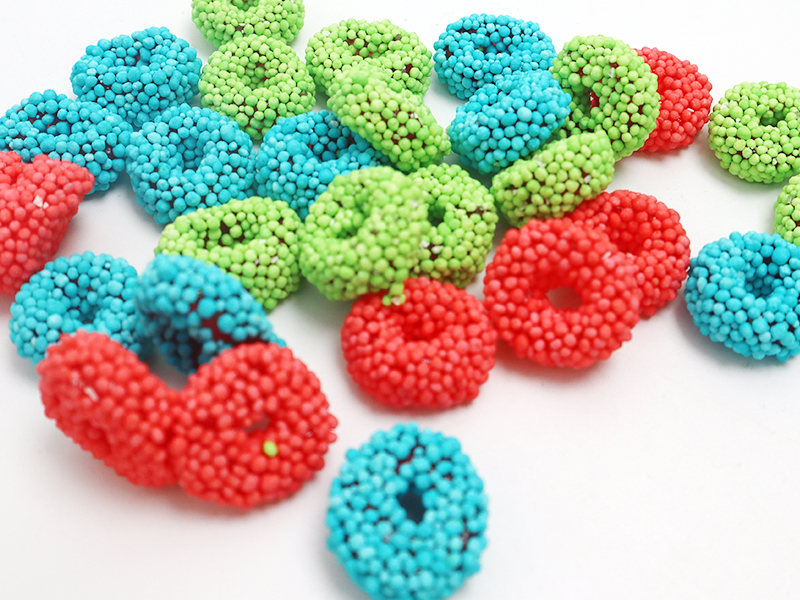
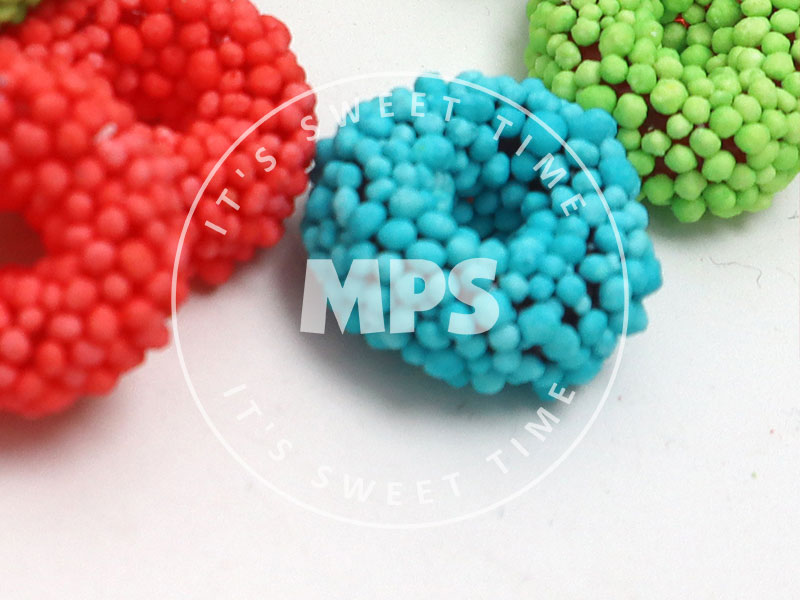
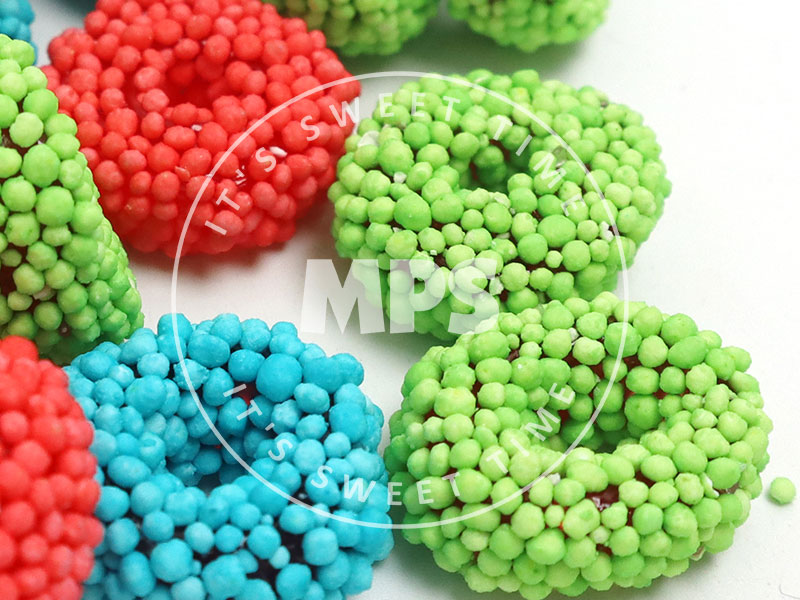
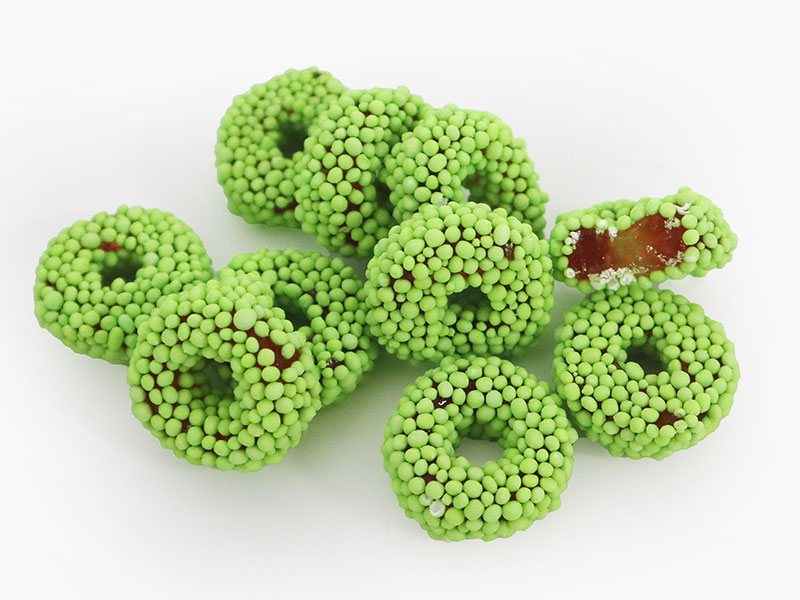
Crunchy gummy rings use the same recognizable format but change one important part of the eating experience.
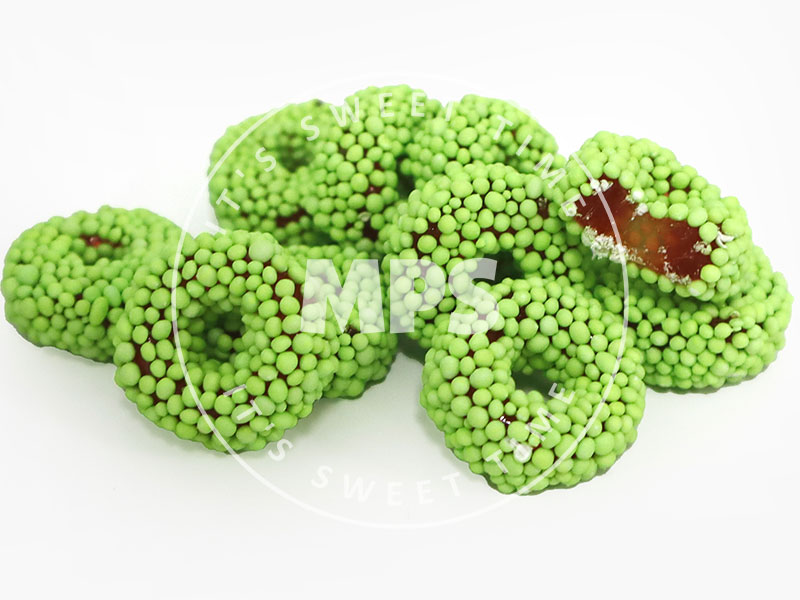
Instead of being soft and chewy from the first bite, they add a crisp candy coating around the gummy center.
The result is:
crunchy outside + chewy inside.
For consumers, this difference is easy to understand.
For brands, importers, distributors and retail buyers, however, the more useful question is:
Does the additional texture create enough commercial value to justify choosing a crunchy gummy ring instead of a traditional gummy ring?
The answer depends on the market, sales channel, target price and role the product is expected to play within the wider candy range.
What Is the Main Difference?
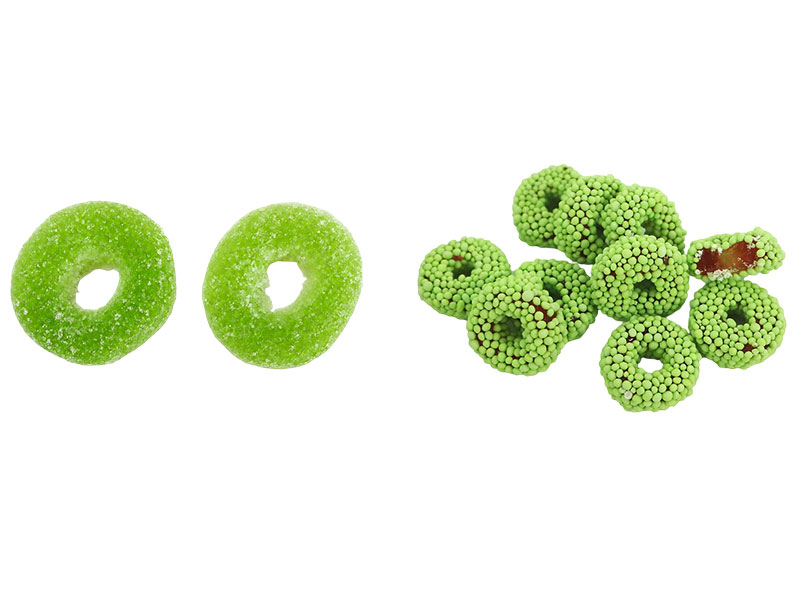
A traditional gummy ring is primarily built around one texture: chewiness.
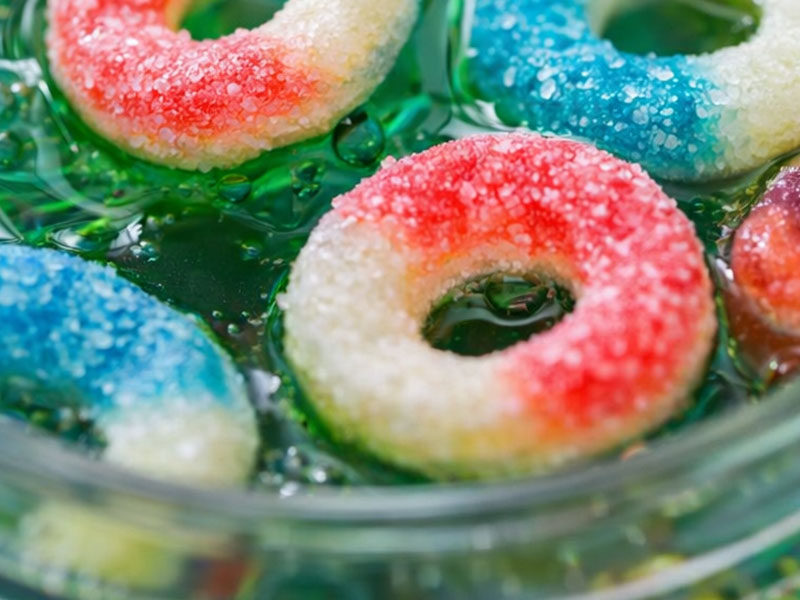
It may be plain, sugar-coated or sour-sanded, but the gummy itself remains the main part of the eating experience.
A crunchy gummy ring introduces a second structural layer.
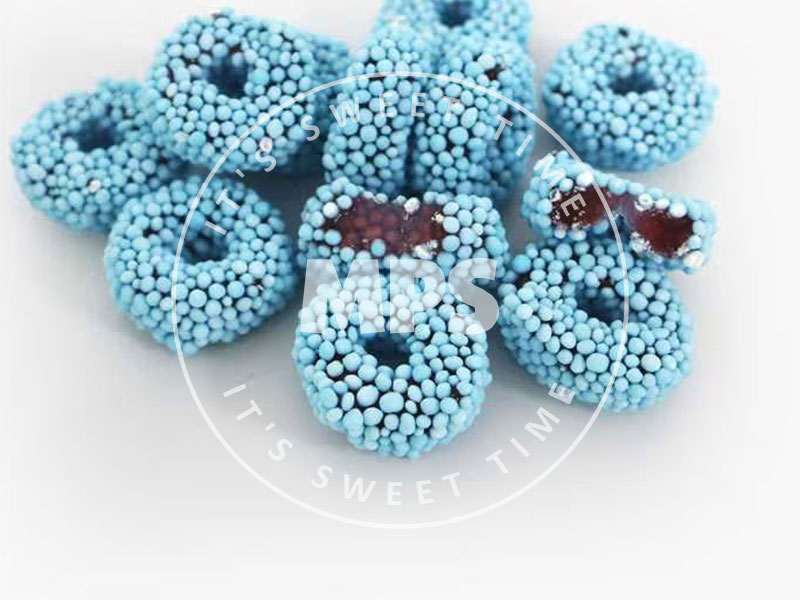
The outer candy coating provides a noticeable crisp bite before the consumer reaches the soft gummy underneath.
This means the difference is not simply visual.
The products create two different sensory experiences.
| Buying Factor | Crunchy Gummy Ring | Traditional Gummy Ring |
|---|---|---|
| Main texture | Crunchy outside, chewy inside | Primarily soft and chewy |
| Surface | Crisp candy coating | Plain, sugar-coated or sour-sanded |
| Consumer familiarity | Newer, more differentiated | Highly familiar |
| Shelf differentiation | Higher | Moderate |
| Product story | Texture contrast | Flavor, sourness and chew |
| Manufacturing complexity | Relatively higher | Relatively simpler |
| Packaging focus | Texture and coating protection | Stickiness, moisture and deformation |
| Typical positioning | Innovation, novelty, premium extension | Mainstream, core assortment, value |
| Private-label potential | High | High |
Neither format is automatically better.
They simply perform different roles.
Traditional Gummy Rings Win on Familiarity
The greatest strength of a traditional gummy ring is that consumers already know what to expect.
A colorful ring-shaped gummy does not need much explanation.
The buyer can focus on familiar points such as:
- Fruit flavor
- Sourness
- Color
- Pack size
- Brand
- Price
This familiarity is useful for large-volume retail programs.
A supermarket that wants a reliable gummy assortment may prefer a traditional ring because the product already fits naturally within the category.
A distributor can also offer the same basic format across different channels without requiring much consumer education.
Traditional gummy rings therefore work particularly well as core SKUs.
They are familiar enough to support repeat purchasing and flexible enough to be adapted into different flavor and packaging combinations.
The disadvantage is that familiarity also creates competition.
If a shelf contains several peach rings, watermelon rings and sour rings, another similar gummy may have difficulty standing out unless the brand, flavor or price provides a strong reason to choose it.

Crunchy Gummy Rings Win on Texture Differentiation
Crunchy gummy rings address this problem in a different way.
Instead of changing only the flavor, they change how the product feels when eaten.
The first bite is crisp.
The next stage is chewy.
This gives the consumer a more noticeable transition than a traditional gummy normally provides.
For a retail buyer, this matters because the difference can be communicated quickly:
Crunchy first. Chewy after.
The product can also show that difference visually.
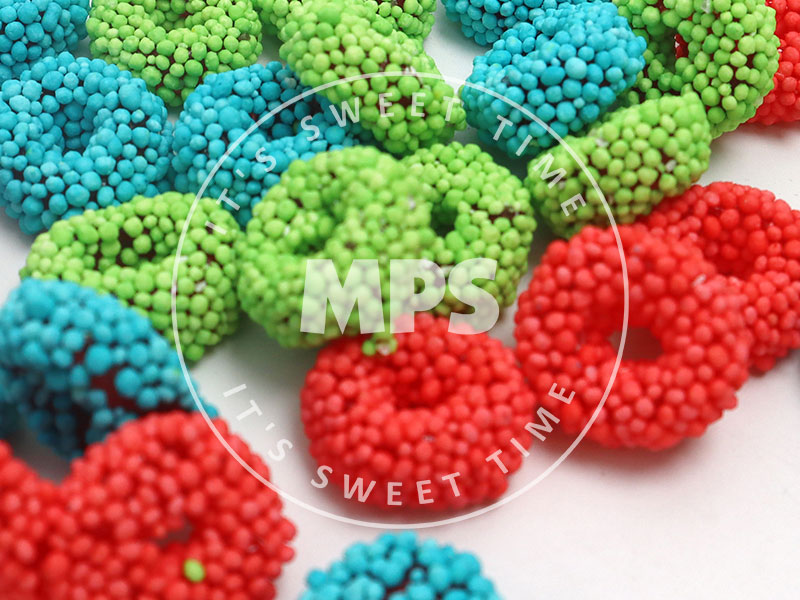
A colorful candy coating creates a more dimensional surface than fine sugar or sour powder, making the ring easier to distinguish in transparent packaging, photography and short-form video.
This does not mean that every consumer will automatically prefer the crunchy version.
It means the product has a clearer innovation story.
For brands and retailers trying to introduce something new without leaving the familiar gummy category entirely, that can be valuable.
Flavor Differentiation vs. Texture Differentiation
Traditional gummy innovation often begins with flavor.
A supplier may offer:
strawberry, peach, grape, apple, watermelon, blue raspberry or mixed fruit.
Brands can also change sourness, color and package design.
These are useful forms of differentiation, but competitors can often make similar changes.
Texture creates another layer that is more immediately noticeable.
A crunchy-coated ring does not merely taste different.
It behaves differently in the mouth.
This creates a stronger product message.
Compare:
New Watermelon Gummy Rings
with:
Crunchy Watermelon Gummy Rings — Crisp Outside, Chewy Inside
The second product provides two pieces of information:
- what flavor it is;
- what makes the eating experience different.
For a crowded category, that second point can help a new SKU establish a clearer identity.
Which Product Has Stronger Shelf Impact?
Crunchy gummy rings generally have the advantage when visual differentiation is the priority.
The textured coating gives the product a more complex surface and can create strong color contrast.
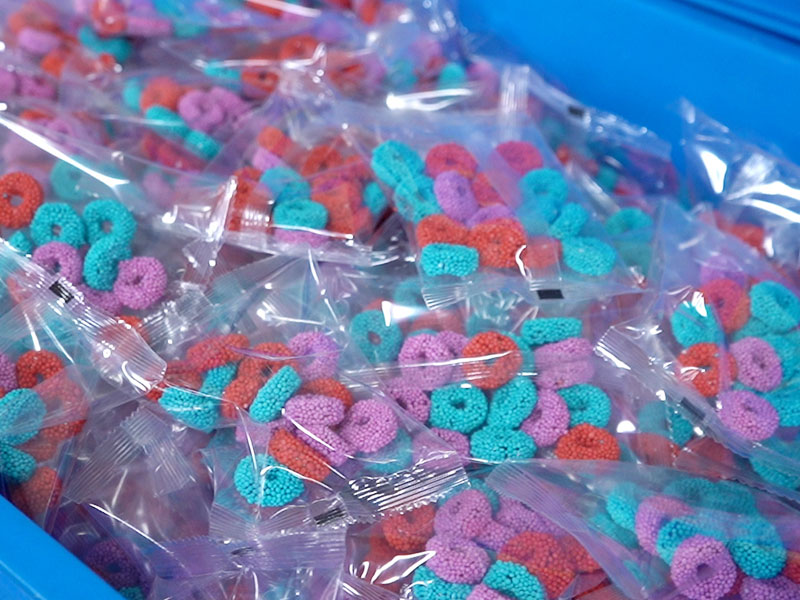
This is particularly useful when the product can be seen through:
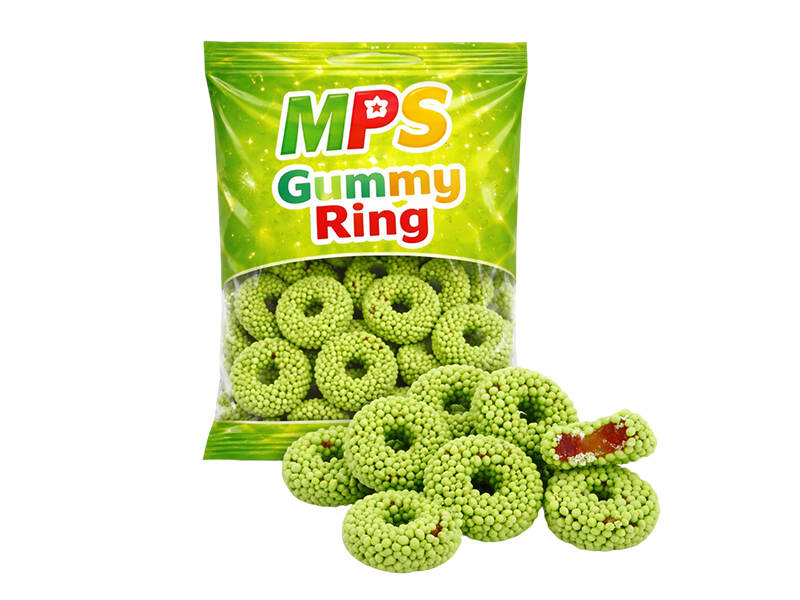
- Clear pouches
- Packaging windows
- Transparent jars
- E-commerce photography
Traditional gummy rings are still highly visual because of their recognizable shape and bright colors, but their surface tends to look more familiar.
Their shelf performance therefore depends more heavily on packaging design, flavor assortment, branding and price.
For a retailer building a stable everyday gummy range, this may be perfectly suitable.
For a buyer looking for an innovation SKU, the crunchy version creates more immediate visual separation.
Which Product Works Better in Supermarkets?
For supermarkets, the answer may not be one or the other.
The two products can play different roles.
A traditional gummy ring is often better suited to the core assortment.
It provides:
- Familiarity
- Broad consumer understanding
- Flexible price positioning
- Easy category placement
A crunchy gummy ring may work better as:
- A new-product introduction
- A premium extension
- A retailer-exclusive SKU
- A seasonal product
- A novelty gummy line
For example, a supermarket could keep traditional peach rings as an everyday item while introducing crunchy fruit rings as part of an innovation or specialty section.
In this situation, the crunchy product does not replace the traditional one.
It expands the category.
Which Product Works Better in Convenience Stores?
Convenience-store products need to communicate quickly.
Shelf and counter space is limited, and purchasing decisions often happen within seconds.
This can favor crunchy gummy rings because the product has a simple message:
a familiar gummy ring with a new crunchy coating.
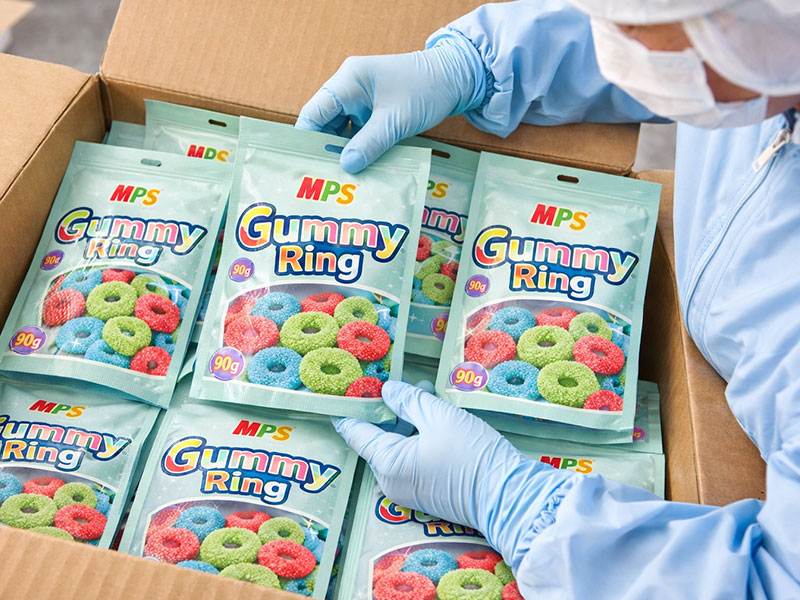
A small retail pouch can show the colorful pieces clearly while communicating the texture difference on the front of the package.
Traditional gummy rings still have an advantage when price sensitivity is the primary concern.
If the product is intended to compete as a standard impulse candy at a highly competitive price point, the extra coating process may not create enough additional value.
The buyer therefore needs to decide whether the convenience-store opportunity is based mainly on:
price and familiarity
or:
novelty and differentiation.
Which Product Works Better for E-Commerce?
Online candy retail creates another set of priorities.
Consumers cannot taste the product through a screen.
They rely on:
- Product photography
- Packaging design
- Video
- Reviews
- Product descriptions
This gives highly visual products an advantage.
Crunchy gummy rings can be particularly suitable for video because the coating and texture can be shown through close-up photography, cutting, biting or product handling.
The contrast between the crisp exterior and chewy center provides more visual storytelling than a standard gummy ring.
Traditional gummy rings remain suitable for online retail, especially when they already have strong flavor recognition or branding.
But when a brand is looking for a product that can generate more visually distinctive content, the crunchy format may provide additional possibilities.
Which Is Better for Private Label?
Both formats offer strong private-label potential.
The difference lies in how the buyer creates differentiation.
Traditional Gummy Rings
Private-label development usually focuses on:
- Flavors
- Colors
- Sourness
- Assortments
- Package weights
- Packaging design
This route is relatively straightforward because the product structure is already familiar.
Crunchy Gummy Rings
Crunchy versions add more variables:
- Coating appearance
- Coating color
- Particle combination
- Gummy-to-coating contrast
- Texture positioning
For example, a buyer might develop:
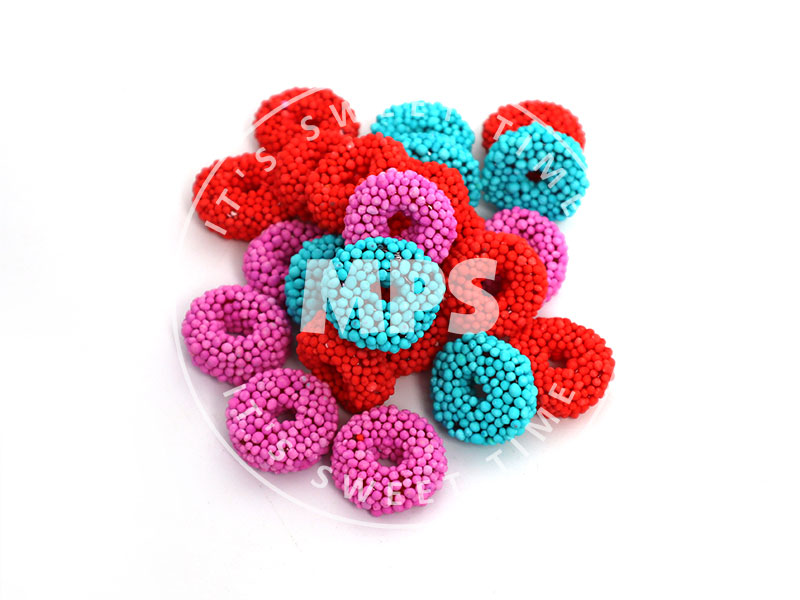
a strawberry gummy with pink and white coating;
a blue raspberry version with blue crunchy particles;
or a mixed-color range where each color represents a different flavor.
This gives brands more opportunities to build a recognizable product family.
However, more customization also creates more manufacturing decisions.
The most effective private-label project is not necessarily the one with the greatest number of variations.
It is the one where the flavor, appearance, coating, package and target price work together commercially.

Manufacturing Complexity Is Different
This is one area where traditional gummy rings have an advantage.
A conventional gummy ring usually follows a relatively established manufacturing structure.
The factory needs to control the gummy formula, shape, color, flavor, sugar or sour coating and packaging.
Crunchy-coated products introduce additional variables.
The manufacturer also needs to consider:
- Coating adhesion
- Coating coverage
- Particle loss
- Moisture movement
- Texture retention
- Packaging protection
The gummy center needs to remain soft enough to provide the intended chew while also remaining stable during coating and packing.
The outer layer needs to remain reasonably crisp.
These two goals can sometimes work against each other because a soft gummy naturally contains more moisture than a dry crunchy coating.
This means the product should be evaluated as a complete system rather than as “a gummy plus some crunchy particles.”

Packaging Requirements Are Also Different
Traditional gummy rings need protection against:
- Heat
- Moisture
- Stickiness
- Deformation
Crunchy gummy rings need the same protection, but the coating adds another concern.
The package should help prevent excessive movement and moisture exposure.
If products move too aggressively inside the package during transportation, more coating may loosen.
If the barrier is not suitable for the product and destination conditions, the crunchy surface may gradually soften.
This becomes especially important for international B2B orders.
The candy may spend weeks in:
production, warehousing, sea transportation, customs clearance and local distribution.
A product that looks and tastes good immediately after production still needs to arrive at the destination in commercially acceptable condition.
Does the Crunchy Version Cost More?
The final cost depends on the complete project.
A crunchy gummy ring may involve additional ingredients, coating processes and production controls compared with a traditional gummy.
Packaging may also require more attention.
However, comparing only manufacturing cost can be misleading.
The better question is:
Does the additional texture create enough retail value to support the product’s intended price and positioning?
If the buyer wants the lowest-cost standard gummy ring, the traditional format may make more sense.
If the buyer wants a more differentiated product that can support novelty, premium or innovation positioning, the additional complexity of a crunchy version may be justified.
The commercial decision should be based on the complete retail proposition rather than the factory price alone.
Should a Brand Replace Traditional Gummies with Crunchy Gummies?
Usually, there is no need to think in terms of replacement.
The two formats can coexist.
A brand could use:
Traditional Gummy Rings
as the core range.
Then add:
Crunchy Gummy Rings
as the innovation range.
This creates a natural product architecture.
For example:
Core Range
- Peach Ring
- Apple Ring
- Watermelon Ring
Crunchy Range
- Crunchy Strawberry Ring
- Crunchy Blue Raspberry Ring
- Crunchy Mixed Fruit Ring
The consumer still recognizes the ring shape, while the brand creates a second product family based on texture.
For importers and distributors, this also provides another way to offer customers different price points and product stories without moving into a completely different confectionery category.
Which Format Is Better for Your Market?
The decision becomes easier when the buyer defines what the product is supposed to achieve.
Choose a traditional gummy ring when the priorities are:
consumer familiarity, mainstream positioning, straightforward product communication and high-volume distribution.
Choose a crunchy gummy ring when the priorities are:
texture innovation, shelf differentiation, novelty positioning, private-label development and stronger visual storytelling.
Neither format is universally superior.
A traditional gummy may be commercially stronger in one market, while a crunchy version may perform better where consumers actively look for new textures and novelty products.
The product should therefore be selected according to:
- Target consumer
- Retail channel
- Price positioning
- Brand strategy
- Packaging
- Expected order volume
Frequently Asked Questions
1. Are crunchy gummy rings the same as sugar-coated gummy rings?
No. Sugar-coated gummies normally use fine sugar or sour crystals. Crunchy gummy rings use a more substantial candy coating designed to create a noticeable crisp texture before the chewy gummy center.
2. Are crunchy gummy rings freeze-dried?
No. Freeze-dried gummies become crunchy throughout after moisture is removed. Crunchy candy-coated gummy rings retain a soft chewy center and obtain their crunchy texture mainly from the outer coating.
3. Which type is better for supermarkets?
Traditional gummy rings may work well as permanent core products, while crunchy rings can be used for innovation, premium, seasonal or retailer-exclusive programs.
4. Which is better for private label?
Both formats work well. Traditional rings offer straightforward flavor, color and packaging customization, while crunchy rings provide additional differentiation through texture and coating.
5. Can crunchy gummy ring flavors and colors be customized?
Yes. Suitable flavors, colors, assortments and packaging formats can be developed according to commercial project requirements.
6. Can traditional and crunchy gummy rings be sold together?
Yes. They can form two related product families: a core traditional range and a more differentiated crunchy range.
7. What is the MOQ for crunchy gummy rings?
MOQ varies by product and packaging format. For many candy products, the typical MOQ is approximately 2–4 metric tons per flavor. For piece-counted, individually wrapped, molded or highly customized products, MOQ may instead be calculated by pieces, packaging quantity or production batch. Each selected flavor, color or style may have its own MOQ depending on the product.
Different qualifying flavors and MPS products can be combined in one container. If needed, your shipment can also be consolidated with goods from your other suppliers in China. For better freight efficiency, we generally recommend arranging the total shipment on a full-container basis.
Gummies, chocolate and other heat-sensitive products must be shipped in a reefer container.
Traditional or Crunchy: Choose the Role First
Traditional gummy rings remain successful because they are familiar, flexible and easy for consumers to understand.
Crunchy gummy rings take that same familiar format and introduce a stronger textural reason to notice it.
For B2B buyers, the key is not deciding which candy is universally better.
It is deciding which product role the market needs:
a familiar core gummy or a more differentiated texture-driven extension.
MPS Candy is a China-based candy manufacturer and exporter supporting traditional gummies, crunchy candy-coated gummies, private-label development and OEM/ODM production for international B2B buyers.