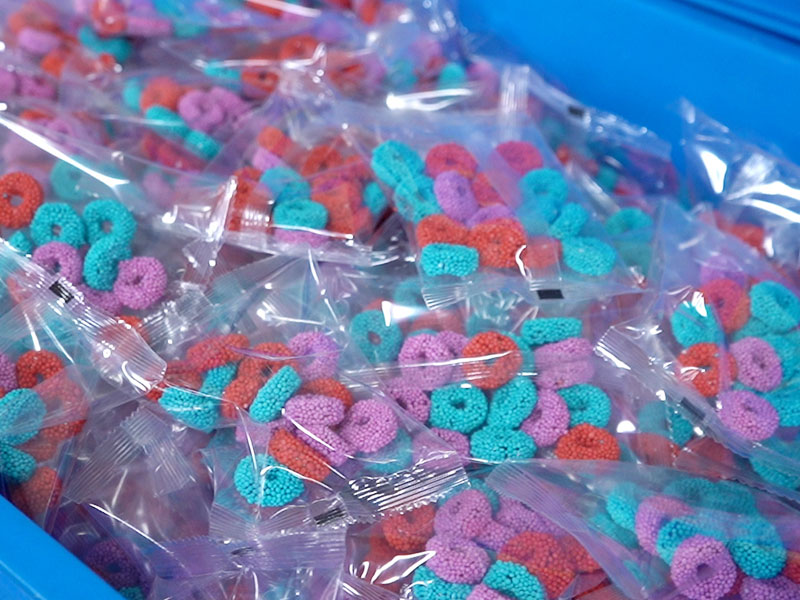
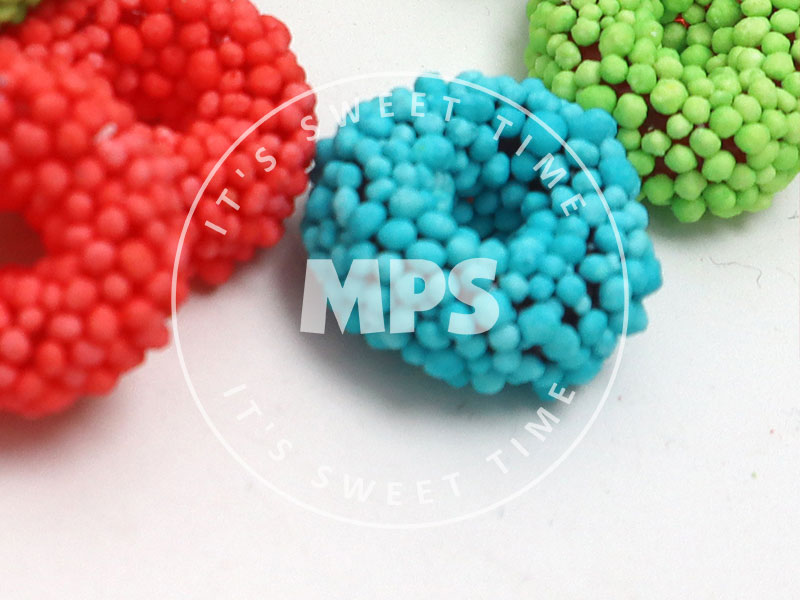
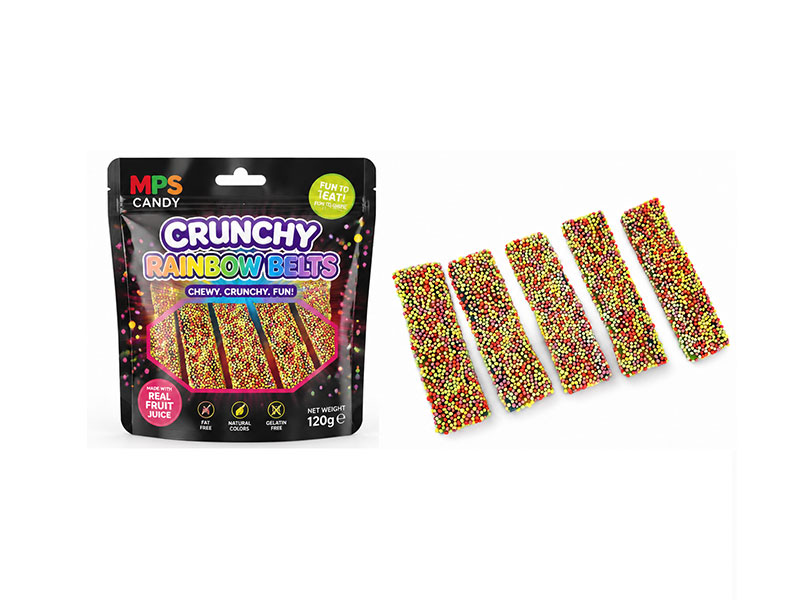
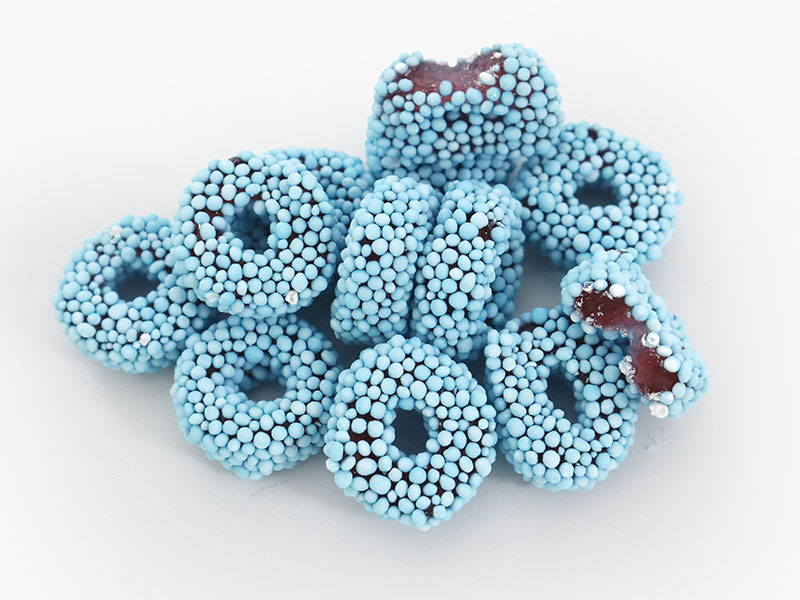
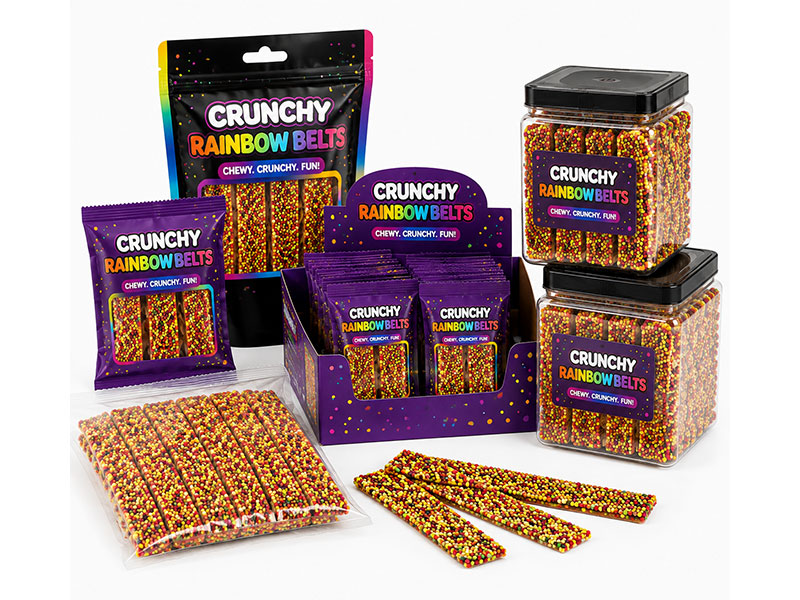
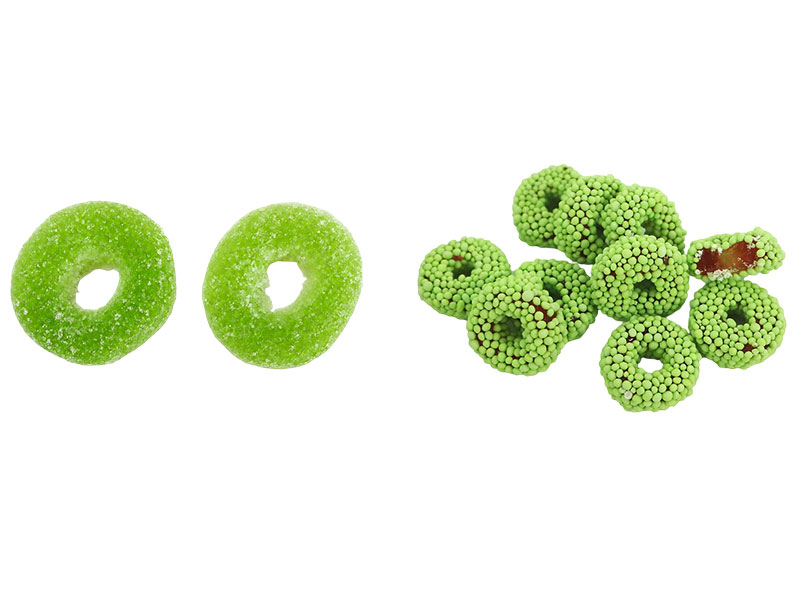
Once the core product structure is established—a crisp candy coating around a soft and chewy gummy center—the same texture idea can be developed into other shapes that create different visual identities, eating experiences and retail opportunities.
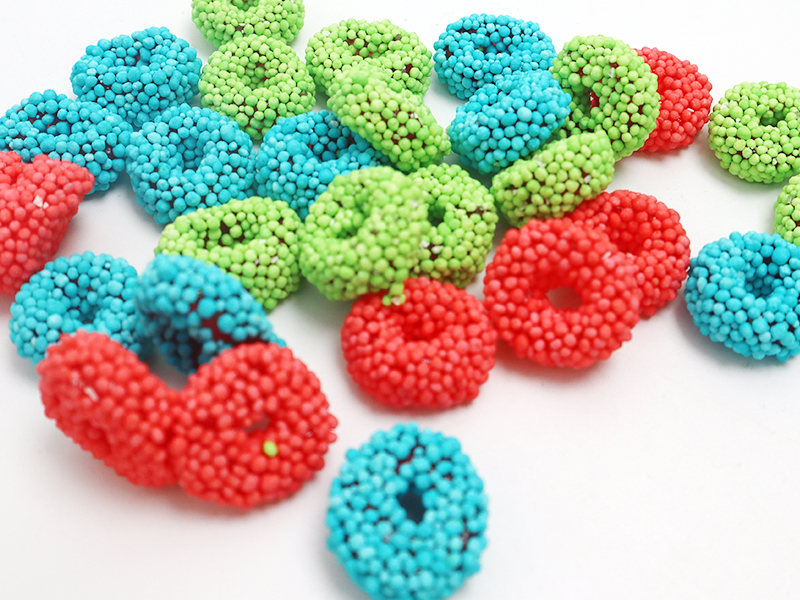
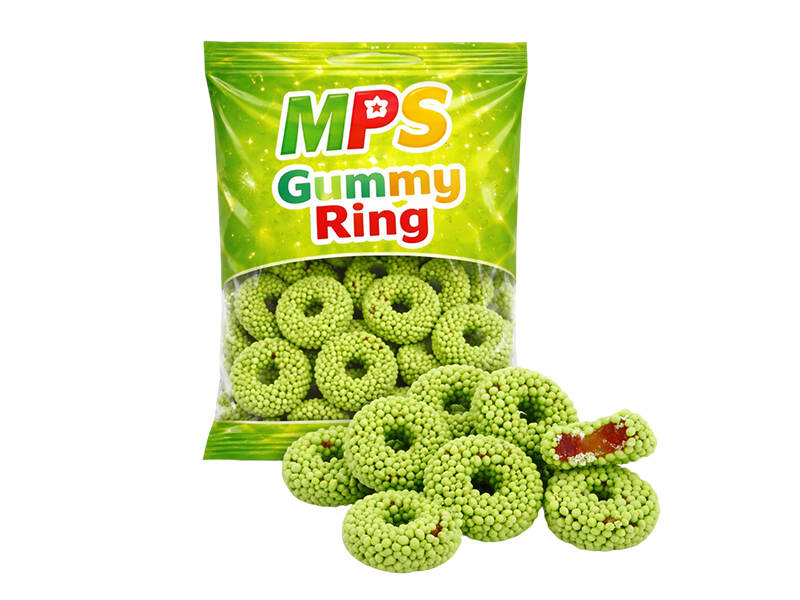
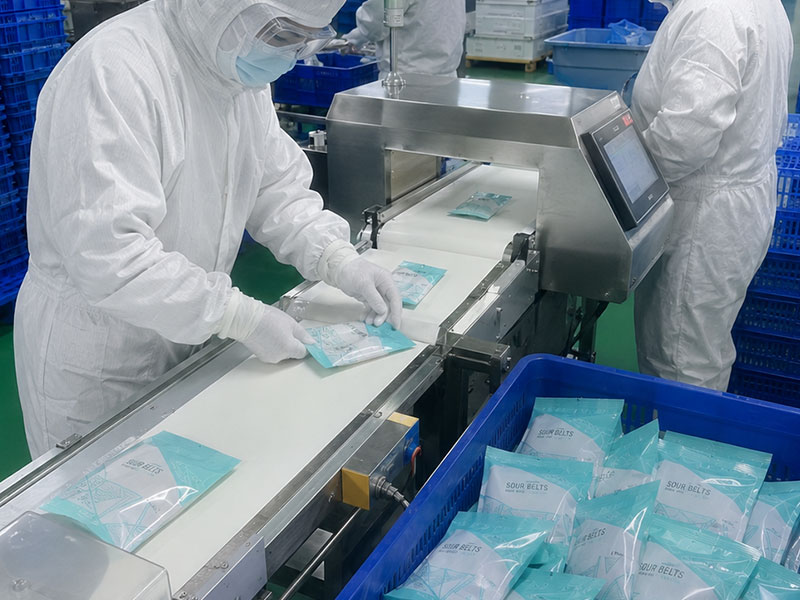
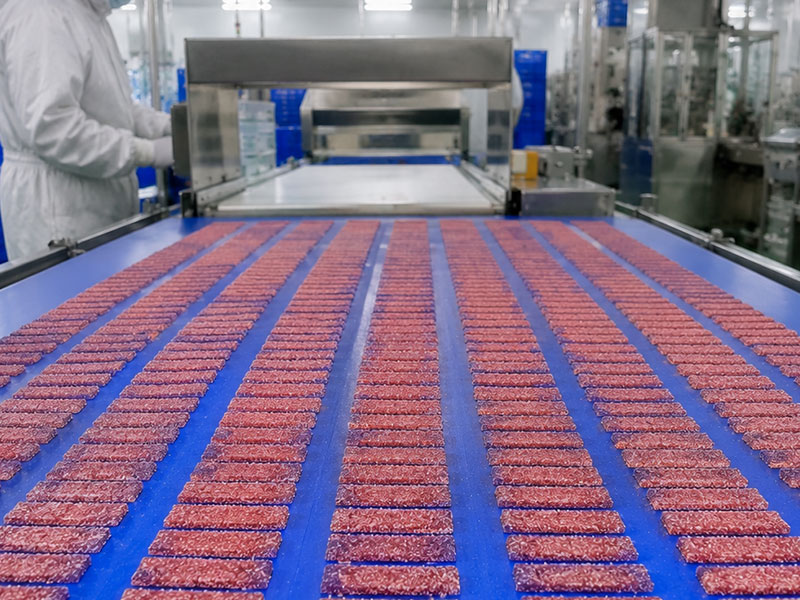
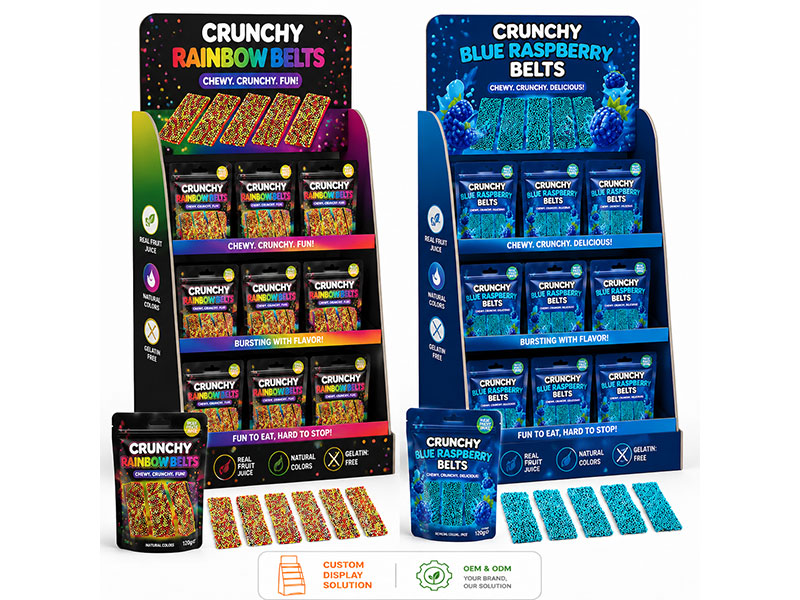
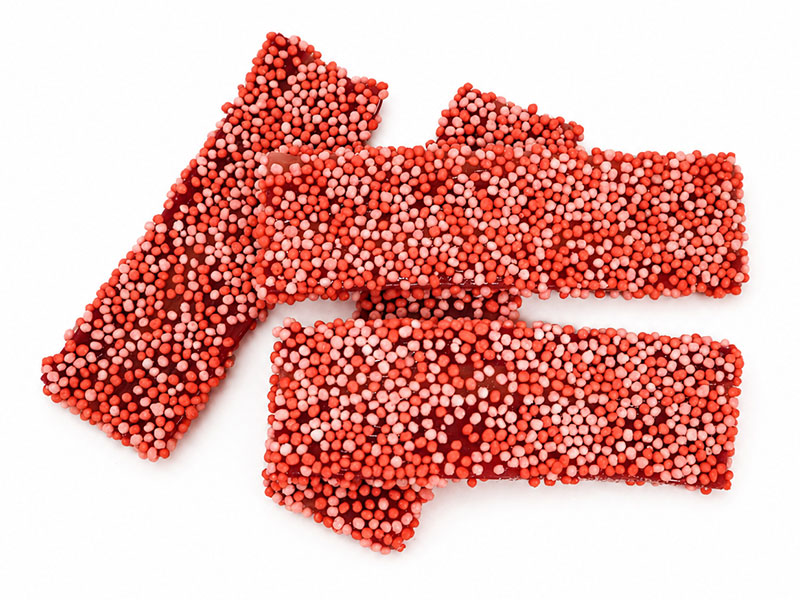
At MPS Candy, the current crunchy candy-coated gummy range includes rings, stars and flat gummy worms.
These shapes can be used as individual products, but the bigger opportunity for brands, importers and distributors is to treat them as part of one coordinated product family.
Instead of asking:
“Which crunchy gummy shape should we sell?”
a better question may be:
“How can different shapes help us build a stronger crunchy gummy range?”
Why Shape Matters in Gummy Product Development
Shape is often treated as a visual decision.
In reality, it affects much more than appearance.
The shape of a gummy influences:
How consumers recognize the product
How much coating is visible
How the candy is picked up and eaten
How many pieces fit into a package
How the product moves during coating and packing
How efficiently cartons and retail packs can be filled
How easily different SKUs can be distinguished
This means two gummies with the same flavor and coating can still create different consumer experiences simply because their shapes are different.
A ring feels familiar and easy to understand.
A star feels more decorative and themed.
A long flat worm creates a more playful, extended eating experience.
For brands, shape can therefore become part of the product architecture rather than simply a cosmetic change.
From One Crunchy Gummy to a Product Family
A common way to develop a candy range is to start with one successful format and then change flavors.
For example:
Strawberry ring
Apple ring
Blue raspberry ring
Watermelon ring
This is a straightforward line-extension strategy.
But there is another approach.
The brand can keep the same core texture concept while introducing different shapes for different SKUs.
For example:
Product
Possible Role
Crunchy Gummy Ring
Core product / mixed fruit range
Crunchy Gummy Star
Novelty, seasonal or themed SKU
Crunchy Gummy Worm
Fun, playful or youth-oriented SKU
Custom Shape
Retail-exclusive or brand-specific development
The common identity remains:
crunchy outside + chewy inside.
The shape gives each product its own personality.
This makes the range easier to expand without turning every SKU into an unrelated candy.
Crunchy Gummy Rings: The Familiar Starting Point
The ring remains one of the strongest starting shapes for this category.
Consumers already know gummy rings from peach rings, apple rings and sour ring assortments.
That familiarity reduces the amount of explanation required at retail.
The crunchy coating then provides the new element.
This creates a useful balance:
familiar shape + unfamiliar texture.
The open center also helps the coating remain visible from several angles, especially in transparent pouches and jars.
For buyers introducing the crunchy concept for the first time, the ring can therefore act as a strong core SKU.
It is recognizable enough for mainstream consumers while still different enough to support novelty or innovation positioning.
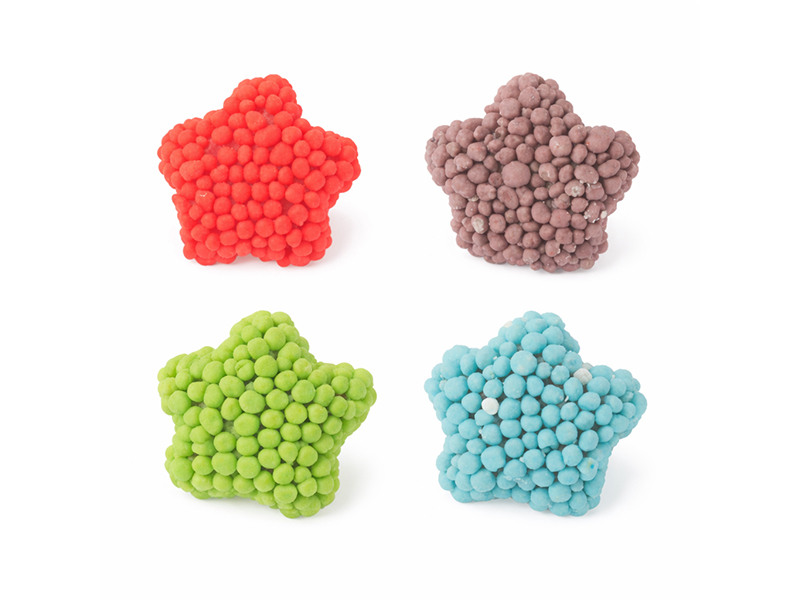
Crunchy Gummy Stars: A More Visual Shape
The star creates a very different impression.
Unlike the rounded ring, it has multiple points and edges, giving the candy a more decorative silhouette.
This can make the coating appear more visually dynamic because the candy particles sit across flat surfaces, corners and pointed edges.
From a retail perspective, stars can work especially well when the product needs to communicate:
Celebration
Fantasy
Space
Party themes
Seasonal collections
Bright novelty candy
The shape also allows brands to move beyond the familiar fruit-gummy appearance.
A ring is naturally associated with classic gummy categories.
A star can feel more like a designed product.
That difference can be useful for private-label brands that want the crunchy texture to become part of a stronger visual identity.
Where Crunchy Gummy Stars May Fit
Crunchy gummy stars can potentially support several types of programs.
For an everyday candy range, they may be used as a colorful mixed-flavor SKU.
For seasonal products, the shape can be coordinated with packaging and color themes.
For example, star-shaped products may work naturally with:
Christmas collections
Space-themed candy
Birthday ranges
Party candy
Fantasy or galaxy packaging
The same mold does not have to communicate the same theme in every market.
Packaging, color and flavor direction can completely change how the final product is positioned.
This is one reason shape should be considered together with the intended retail concept rather than selected in isolation.
Crunchy Gummy Worms: A Different Eating Experience
Worm-shaped gummies have long been popular because they encourage a more playful style of eating.
A flat crunchy gummy worm builds on that familiarity while adding a new surface texture.
Compared with a ring or star, the elongated shape gives consumers a longer piece to bite, hold or tear.
The interaction is different.
A ring may be eaten in one or two bites.
A longer worm creates repeated contact with the crunchy coating as the consumer continues eating the piece.
This can make the texture contrast more noticeable throughout the eating experience.
The elongated shape also creates strong visibility inside transparent packaging.
Several worms placed together can produce a layered, colorful presentation that looks different from a bag filled with smaller round gummies.
Why Flat Worms Are Different from Traditional Gummy Worms
Traditional gummy worms are often relatively narrow and rounded.
The crunchy version can benefit from a flatter structure because it provides more surface area for the coating.
More surface area can make the candy particles easier to see and help the product communicate its crunchy character before the package is opened.
However, a larger surface area also introduces manufacturing considerations.
The factory must control:
Coating distribution
Product flexibility
Breakage
Thickness
Product movement
Packing efficiency
A very thin piece may deform.
A very thick piece may change the eating experience.
A long product may also require a different package size from a ring.
The goal is therefore to create a worm shape that works visually and technically, not simply to make the longest possible candy.
How Shape Changes the Coating Experience
One of the more interesting aspects of crunchy candy-coated gummies is that the same coating can behave differently on different shapes.
Consider three products:
Ring
The coating follows both the outer and inner surface of the candy.
This can create a visually dense coating effect.
Star
The coating covers flat areas as well as pointed edges.
This can emphasize the shape but may also require attention to coating uniformity around corners.
Worm
The coating is distributed across a longer surface.
This can create a broader area of crunchy texture but may also increase handling and movement during packaging.
These differences mean that a shape should not be approved only from a drawing.
The product needs to be sampled and evaluated as an actual coated gummy.
Custom Shapes: When Does a New Mold Make Sense?
A custom shape can create stronger differentiation, but it should have a clear commercial purpose.
Developing a completely new mold may make sense when:
The shape is part of the brand identity
A retailer wants an exclusive product
The shape supports a seasonal program
Existing molds cannot communicate the concept
The expected commercial volume justifies development
It may make less sense when the only objective is to make a small visual change that consumers may not notice.
Custom molds can affect:
Development time
Tooling cost
Sampling
Production setup
Piece weight
Packaging dimensions
MOQ
For this reason, buyers should compare the value of exclusivity with the additional development requirements.
Sometimes an existing star, ring or worm shape combined with new colors, flavors and packaging can create enough differentiation without developing an entirely new mold.
A Good Drawing Is Not Always a Good Candy Mold
One of the most common misunderstandings in custom candy development is assuming that any 2D design can be turned directly into a production mold.
A shape may look excellent in an illustration but still create manufacturing problems.
Extremely thin sections may tear.
Deep or narrow details may not reproduce clearly.
Sharp points may deform.
Complex surfaces may hold coating unevenly.
Large shapes may change cooling time and piece weight.
Filled products create even more constraints because the outer gummy needs enough structure to hold the center.
For crunchy candy-coated gummies, another question must also be considered:
Will the shape still work after the coating is added?
Small details that are visible on an uncoated gummy may disappear under candy particles.
For this reason, custom gummy shapes sometimes need to be simplified or adjusted before commercial production.
The objective is not to weaken the design.
It is to make sure the shape remains recognizable after molding, coating, packaging and transportation.
Which Shape Is Best for Retail Packaging?
There is no single answer.
Different shapes create different packaging effects.
Rings
Rings generally stack and mix easily and are suitable for pouches, jars and sharing packs.
Stars
Stars can create strong decorative displays but may require more attention to how the pointed pieces interact during transportation.
Worms
Longer gummies take up more visible space and can make a package look fuller with fewer pieces, but the package dimensions need to accommodate their length.
Custom Shapes
Packaging should be evaluated after the final mold size and piece weight are confirmed.
A brand should therefore avoid finalizing the packaging artwork too early.
The physical candy influences:
Pack dimensions
Pieces per bag
Net weight
Product orientation
Window size
Carton configuration
Product and packaging development should move together.
One Shape or Several Shapes?
For a new brand or new category launch, starting with several shapes at the same time is not always necessary.
More SKUs create more complexity.
Each flavor, color, mold and packaging combination may affect production and MOQ.
It requires additional technical evaluation and may involve separate mold and production requirements.
For buyers, the decision should depend on how important the shape is to the final brand concept.
If the shape is central to the product identity, developing a new mold may be justified.
If differentiation can be achieved through flavor, texture and packaging, an existing shape may offer a faster commercial route.
What Should Buyers Evaluate Before Choosing a Shape?
A buyer should not ask only:
“Which shape looks best?”
The better questions are:
Will consumers understand it?
Does the coating remain visually attractive on the shape?
Can the product be produced consistently?
Will it fit the intended packaging?
Does it support the target price?
Can it become part of a broader product range?
A successful candy shape should work from concept through production and retail—not just in a design presentation.
MOQ and Commercial Development
MOQ depends on the selected product and level of customization.
For many candy products, the typical MOQ is approximately 2–4 metric tons per flavor, but this should not be treated as a universal rule for every product.
Piece-counted, individually wrapped, molded or highly customized products may instead have MOQ requirements based on pieces, packaging quantity, mold, style or production batch.
Custom shapes should therefore be evaluated individually before the final MOQ is confirmed.
Different qualifying flavors and MPS products can be combined in one container. Shipment can also be consolidated with goods from the buyer’s other suppliers in China when appropriate.
For better freight efficiency, international orders are generally planned on a full-container basis.
Frequently Asked Questions
1. What crunchy gummy shapes are currently available?
MPS currently offers crunchy candy-coated gummies in ring, star and flat worm formats. Other suitable shapes can be evaluated according to the project.
2. Are crunchy gummy stars different from crunchy gummy rings?
The core crunchy-outside, chewy-inside concept is similar, but the shape changes the visual appearance, surface area, packaging presentation and eating experience.
3. Can I create a custom crunchy gummy shape?
Potentially yes. The design must first be reviewed for molding, coating, packaging and commercial-production feasibility.
4. Does a custom gummy shape require a new mold?
If an existing mold cannot meet the requirement, a custom mold may be necessary. Mold cost, development time and applicable MOQ should be confirmed before development begins.
5. Can rings, stars and worms be sold under one brand?
Yes. They can be developed as separate SKUs within one coordinated crunchy gummy range.
6. Can different shapes use different flavors?
Yes, subject to production feasibility and applicable MOQ. Shape, flavor and color can be coordinated to create different product identities.
7. Is MOQ calculated by shape or flavor?
It depends on the product. For many candy products, MOQ is typically around 2–4 metric tons per flavor, while molded, piece-counted or highly customized products may use different MOQ calculations. The exact requirement should be confirmed for the selected shape and project.
8. Which shape should I choose first?
For a new crunchy gummy range, rings can provide a familiar starting point. Stars and worms may be added when stronger visual differentiation, themed positioning or additional line extensions are required.
Build a Crunchy Gummy Range Beyond Rings
Crunchy gummy rings may be the easiest place to begin, but they do not need to define the entire category.
Stars create a more decorative visual identity.
Worms create a longer and more playful eating experience.
Custom shapes can provide stronger exclusivity when the commercial program justifies deeper development.
The strongest opportunity is to treat these products as one connected platform built around a consistent idea:
Crunchy outside. Chewy inside. Multiple shapes for different retail opportunities.
MPS Candy is a China-based candy manufacturer and exporter supporting crunchy candy-coated gummies, private-label production and OEM/ODM product development for international B2B buyers.
About Shirley Qian
I’m Shirley Qian, Founder of MPS, with 15 years of foreign trade expertise, committed to global confectionery success.
After you submit, we will receive your information and our professional sales staff will contact you within 24 hours. We will protect the security of your information.
Contact us for free samples
Communicate with our professional sales staff about candy wholesale and customization details