
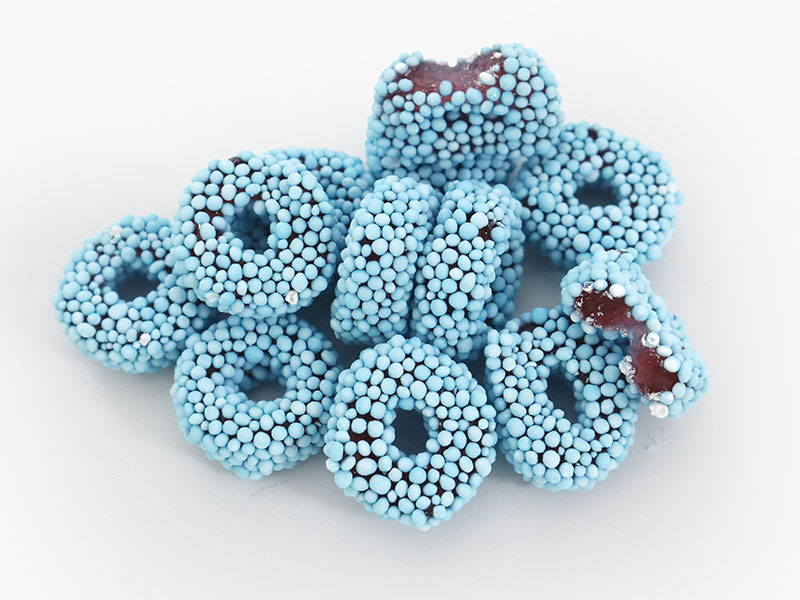
The gummy center and the crunchy coating have very different texture requirements. One needs to remain soft and chewy. The other needs to stay crisp enough to create a clear contrast in the first bite.
Then both need to survive coating, handling, packaging, storage and international transportation while still delivering approximately the same eating experience from the first production batch to the next.
That is what makes crunchy candy-coated gummies interesting from a manufacturing perspective.
The challenge is not simply creating crunch.
It is creating repeatable crunch around a consistently chewy gummy center at commercial scale.
The Product Is Really Two Textures in One System
Traditional gummies are mainly judged by the characteristics of the gummy itself.
Is it soft enough?
Does it have enough elasticity?
Does the flavor remain clean?
Does the product hold its shape?
Crunchy candy-coated gummies introduce another layer.
The outer coating now has its own texture, appearance and physical behavior.
That creates a product with two very different expectations:
the outside should feel crisp and structured, while the inside should remain soft and chewy.
These two parts cannot be developed independently.
A coating that performs well on one gummy formula may behave differently on another.
A very soft gummy may create one coating experience.
A firmer gummy may make the total bite feel too hard.
A thicker coating can increase crunch but may reduce the perceived importance of the center.
Commercial development is therefore less about adding one component to another and more about finding a balance between them.

The Gummy Center Has to Be Right Before the Coating Matters
A crunchy coating can attract attention, but the gummy center still determines much of the final eating experience.
If the center is too firm, the product may feel hard rather than crunchy-chewy.
If it is too soft, the coating may dominate the first bite but the inside may lack enough structure.
The center also needs to maintain its dimensions during production and handling.
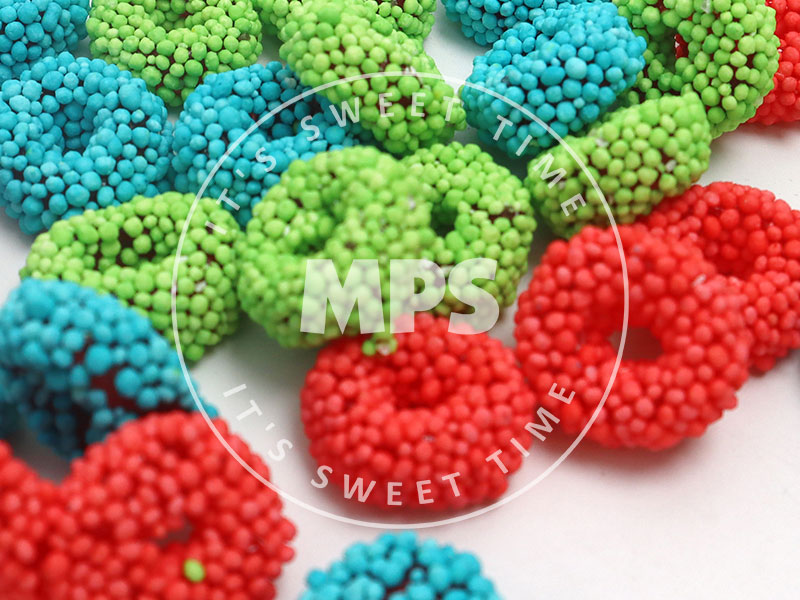
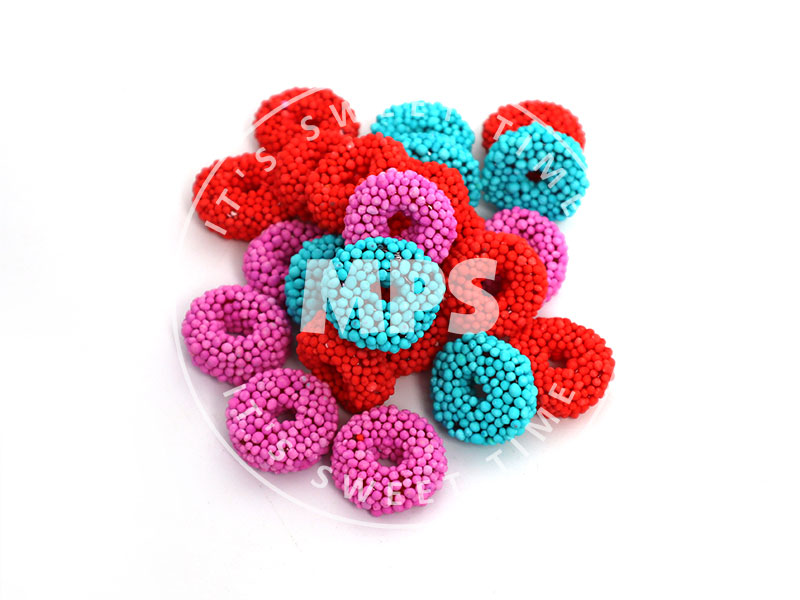
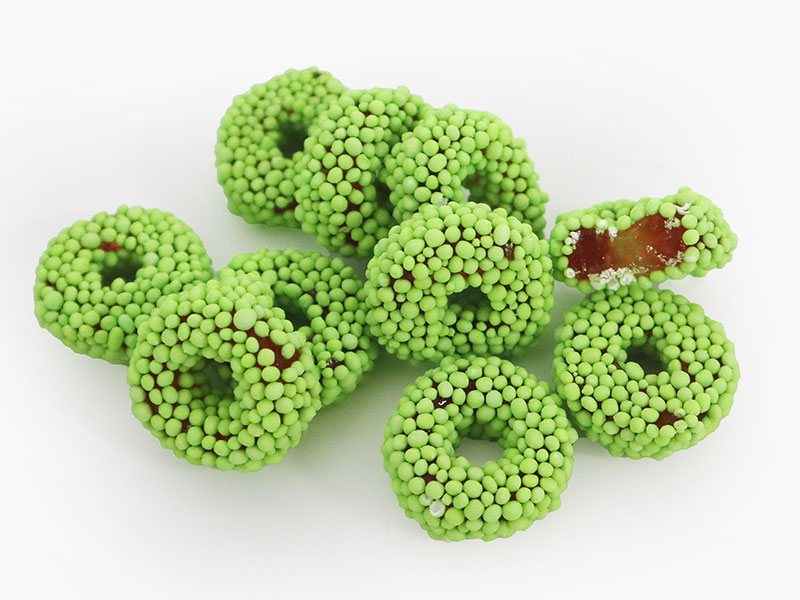
This becomes particularly important with shapes such as rings, stars and flat worms.
A ring must keep its open center.
A star should retain its points well enough to remain recognizable after coating.
A long flat worm needs enough flexibility to remain chewy without becoming difficult to handle.
That is why shape and gummy texture cannot be considered separately.
The correct center needs to work not only when eaten, but also when moving through the rest of the production process.
Coating Adhesion Is More Important Than It Looks
One of the most visible signs of an unstable crunchy gummy is inconsistent coating.
Some pieces may look heavily covered while others look almost bare.
Loose particles may accumulate at the bottom of the package.
The coating may look good immediately after production but become less stable after handling.
The surface condition of the gummy plays an important role here.
A gummy that is too dry may not hold the coating effectively.
A surface that is too tacky may attract too much material or create uneven clusters.
The coating process therefore needs a suitable relationship between gummy surface, coating material and processing conditions.
This is one reason a commercially successful product cannot be judged from a single attractive sample.
The real question is whether the same appearance can be reproduced consistently across a much larger production run.
Uniformity Becomes Harder as Production Gets Larger
A small sample can be carefully adjusted by hand.
Commercial production does not have that luxury.
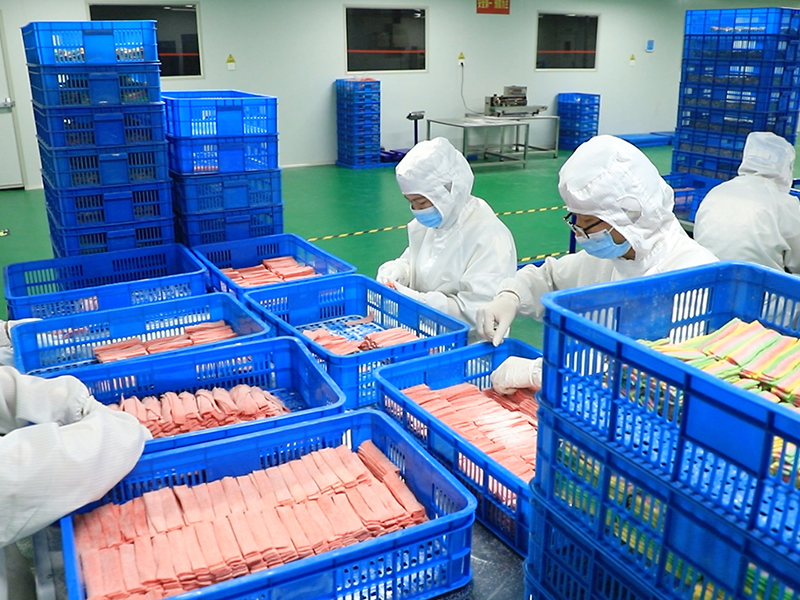
Thousands or millions of pieces need to move through production under repeatable conditions.
At that scale, small variations become easier to see.
A slight difference in gummy size can affect coating coverage.
Different product shapes can move differently during processing.
Variations in coating distribution can affect both visual appearance and eating experience.
This is the transition that often separates a successful laboratory or development sample from a stable commercial product.
| Development Stage | Main Question |
|---|---|
| Initial concept | Does the crunchy-chewy idea work? |
| Development sample | Do the flavor, center texture and coating feel balanced? |
| Pilot / scale-up stage | Can the product remain consistent when batch size increases? |
| Commercial production | Can appearance, texture, weight and coating be reproduced across regular orders? |
| Packed product | Does the intended texture remain acceptable through storage and transportation? |
The product does not simply become “the same sample, only bigger.”
Scale changes how the process behaves.
Shape Changes the Manufacturing Behavior
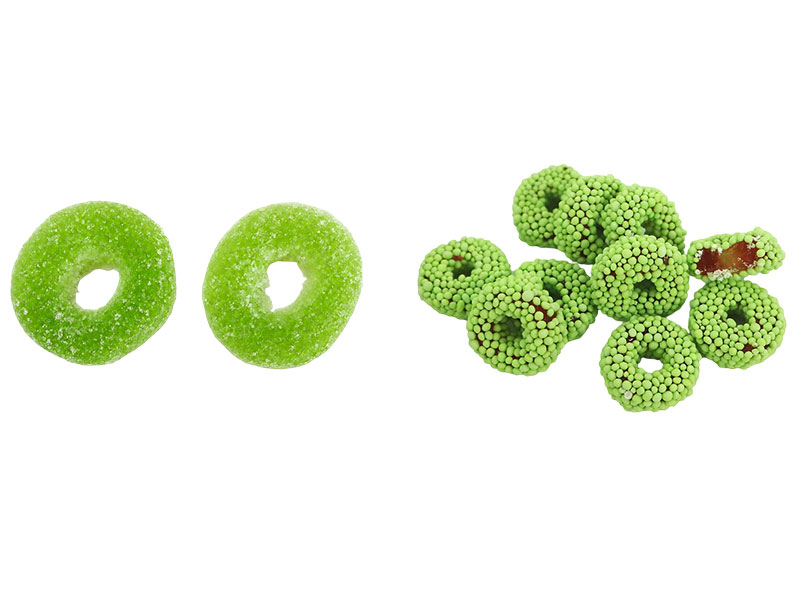
A ring, star and worm may all use the same basic crunchy-coated concept, but they do not necessarily behave the same way during production.
A ring has curved surfaces and an open center.
A star has points, corners and flatter areas.
A worm has a long surface and may flex more during handling.
Those differences influence how pieces contact one another, how much surface area is available for coating and how the finished candy moves through packing.
This is why a new shape should not be evaluated only in a digital drawing or mold rendering.
The physical coated sample matters.
A shape may look highly detailed before coating but lose some of that detail once the outer particles are added.
Another shape may technically work but create more product breakage or packing difficulty than expected.
The best commercial shape is not always the most complex one.
It is the one that remains attractive after the full production process.
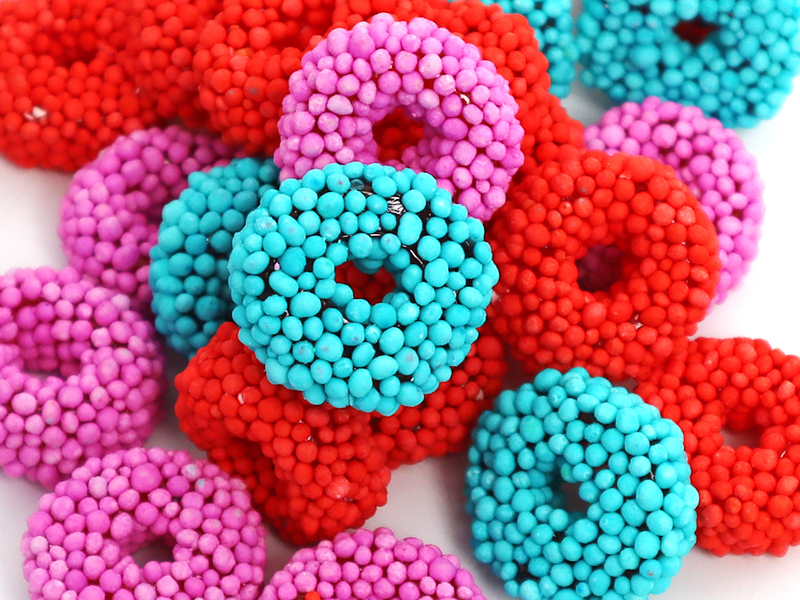
The Coating Has to Create Contrast, Not Just Coverage
A crunchy gummy should not simply look coated.
The coating needs to create a noticeable sensory difference.
That does not mean adding as much coating as possible.
Too little coating may fail to create enough crunch.
Too much can make the product feel heavy, reduce the prominence of the chewy center and increase loose particles inside the package.
The correct level depends on the product concept.
A smaller ring may require a different balance from a large flat worm.
A highly flavored center may need a different coating relationship from a more neutral gummy base.
Commercial development therefore focuses on how the complete bite works rather than judging the coating in isolation.
The consumer should experience a clear sequence:
crisp first contact → chewy center → flavor release.
When those elements feel balanced, the coating becomes part of the product rather than simply something stuck to the surface.
Moisture Is One of the Quiet Challenges Behind Texture
The defining feature of this type of candy is the contrast between a chewy gummy and a crisp exterior.
That contrast can also create a technical challenge.
The gummy center naturally contains more moisture than a dry crunchy coating.
Over time, moisture can move within the product system and influence texture.
If the outer layer absorbs too much moisture, some of its crispness may decrease.
If storage conditions are poorly controlled, heat and humidity can accelerate unwanted changes.
This is why crunchy candy-coated gummies need to be evaluated beyond the day they are made.
A product may taste excellent immediately after production but still need packaging and storage testing to understand how well that texture holds over time.
For commercial buyers, shelf life is not only about whether the candy remains safe or visually acceptable.
It is also about whether the product still delivers the eating experience promised on the package.
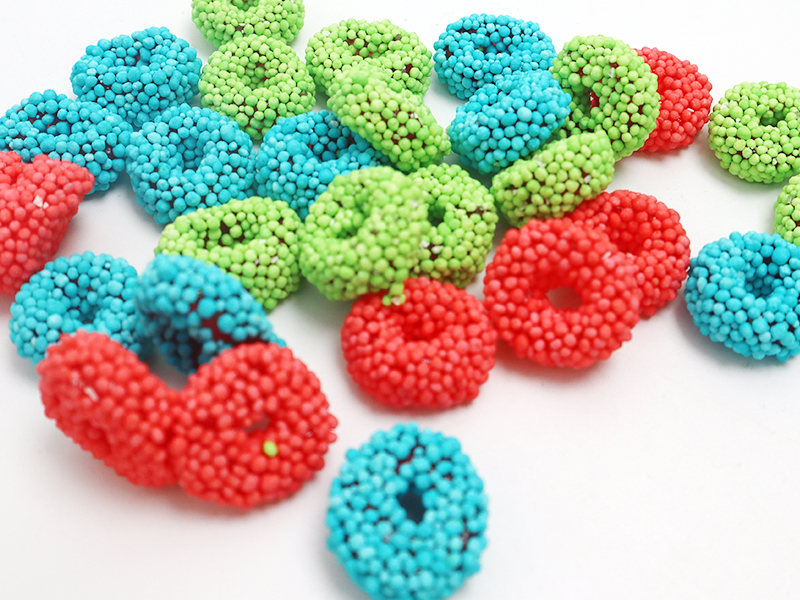
Scale-Up Is Where Small Problems Become Commercial Problems
A development sample can often be adjusted quickly.
Perhaps the coating is slightly too heavy.
Perhaps the gummy is a little too firm.
Perhaps one color does not look correct.
At small scale, these issues may seem minor.
During commercial production, the same issue can affect a large amount of product.
This is why scale-up matters.
The objective is to identify whether the relationships established during development still work when batch size, equipment load, processing time and handling conditions change.
For example, a shape may coat beautifully in a small test but behave differently once much larger quantities are processed together.
A flavor may taste balanced in a freshly prepared sample but need reassessment after the product has been packed and stored.
The development process therefore needs to move gradually from concept to sample to commercial production rather than treating sample approval as the final technical step.
Consistency Matters More Than Creating One Perfect Piece
In product photography, one perfect gummy may be enough.
In manufacturing, that is almost irrelevant.
A commercial buyer needs thousands of packages to look reasonably consistent.
The ring in one bag should not be dramatically different from the ring in another.
Coating should not vary excessively from batch to batch.
Color should remain within an acceptable range.
The center should deliver a similar chew.
This does not mean every candy is physically identical. Confectionery is still a food product, and natural process variation exists.
The objective is controlled consistency.
That is a very different goal from creating one impressive development sample.
For manufacturers, reliable repeatability is often the more difficult achievement.
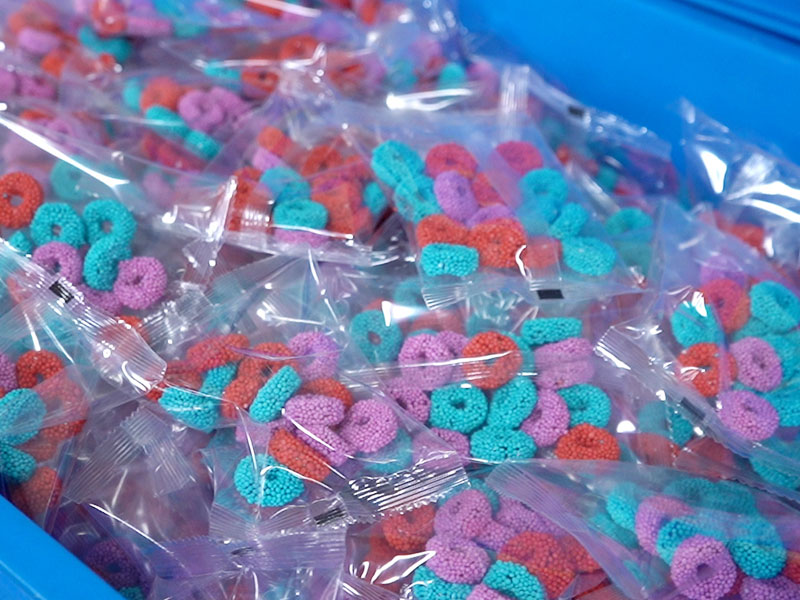
Flavor and Color Also Have to Survive the Process
Texture receives much of the attention in crunchy gummies, but flavor and color still matter.
The outer coating can influence the way the center flavor is perceived.
A strong sour or sweet coating may dominate the first few seconds of the eating experience.
The center flavor then needs to remain noticeable after the coating begins to dissolve.
Color also needs to make sense after the coating is applied.
A bright gummy center may become less visible under a dense coating.
A coating color that looks attractive by itself may not create enough contrast against the center.
This is why final product approval should be based on the complete coated gummy rather than on separate samples of center and coating.
The consumer never eats those components separately.
Different Shapes May Need Different Development Decisions
Once the basic crunchy gummy platform is established, it may seem easy to transfer the same formula and coating to every shape.
In practice, some adjustment may still be needed.
A compact ring and a long flat worm do not create the same ratio of coating to gummy.
The star has different edges and surface geometry.
Piece weight may vary.
The way consumers bite each product also changes.
This means line extensions should preserve the brand concept without assuming that every technical detail has to remain identical.
The objective is consistent product identity, not mechanically identical specifications.
A range can still feel unified if rings, stars and worms all deliver the same core promise:
crunchy outside, chewy inside.
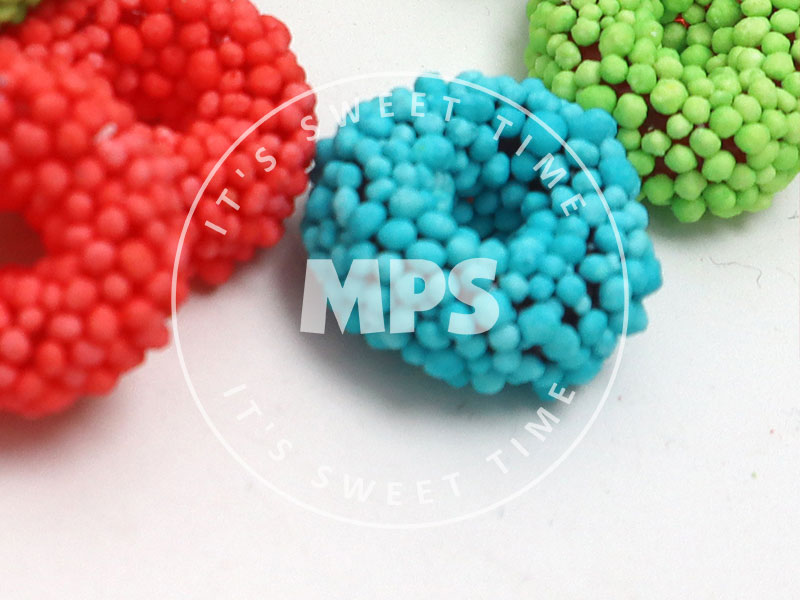
Packaging Becomes Part of the Manufacturing Problem
Once the candy itself works, another question appears:
Can the package preserve it?
For ordinary confectionery, packaging protects against contamination, moisture, oxygen, physical damage and environmental exposure.
For crunchy gummies, it also has to help protect the texture contrast.
If too much moisture reaches the product, the outer layer may soften.
If the product moves excessively during transportation, more coating particles may loosen.
If the package is too small, pieces may be compressed.
If it is too large, unnecessary movement may increase.
The packaging structure therefore needs to be developed around the physical product.
This is one reason final retail packaging should not be selected only from a graphic-design perspective.
The candy and the package form one commercial system.
Why Shipping Conditions Matter for Gummies
Commercial manufacturing does not end when the cartons leave the factory.
International candy projects may spend weeks in transit.
During that period, temperature becomes especially important for heat-sensitive products.
High temperatures can affect gummy texture, product shape and overall appearance.
For this reason, gummies, chocolate and other heat-sensitive products must be shipped in reefer containers for MPS international projects.
This is not simply a logistics preference.
The objective is to help protect the product after the manufacturing team has already spent time establishing the correct texture and appearance.
A poorly controlled shipment can undo part of that work before the candy reaches the buyer.
Quality Control Is About Keeping the Product Inside an Acceptable Range
Quality control for a crunchy gummy is not limited to asking whether the product passes or fails.
Commercial production also needs to monitor whether the product continues to match the approved direction.
That includes the overall appearance of the coating, the gummy center, product dimensions, package weight and other agreed specifications.
For B2B customers, the approved sample acts as an important reference.
The purpose is not to guarantee that every individual candy looks exactly the same.
It is to ensure that commercial production stays within an agreed and commercially acceptable range.
This becomes especially important for repeat orders.
A brand that sells the same SKU for several years needs continuity.
Consumers should not feel that the product has unexpectedly changed every time a new shipment arrives.
Why a Good Manufacturing Project Starts Before Production
Many commercial production problems actually begin much earlier.
If the product brief is vague, the sample process becomes vague.
If the sample approval is vague, the production target becomes vague.
If the package is designed before the candy size is stable, artwork may need to be redone.
If too many flavors are launched before MOQ is considered, the project may become commercially impractical.
Manufacturing quality therefore begins during product development.
The more clearly the buyer and factory define the intended texture, shape, flavor, coating and packaging direction, the easier it becomes to move toward repeatable production.
The factory is not simply reproducing an image.
It is translating a product concept into a process that can be repeated at scale.
From Sample to Commercial Production
The most useful way to think about crunchy gummy manufacturing is not as a single production step.
It is a progression.
First, the concept needs to work.
Then the texture needs to work.
Then the coating needs to remain stable on the selected shape.
Then the product needs to scale.
Then the package needs to protect it.
Finally, the complete product needs to survive storage and transportation while still delivering the intended eating experience.
That is why commercial candy development takes more than approving one attractive sample.
The real achievement is reaching the point where the same product can be manufactured again.
And again.
And again.
What Does MOQ Mean at Commercial Scale?
MOQ depends on the selected candy and packaging structure rather than following one universal rule.
For many candy products, the typical MOQ is approximately 2–4 metric tons per flavor, depending on formula, shape, production process and packaging requirements.
However, piece-counted, individually wrapped, molded or highly customized products may instead use MOQ calculations based on pieces, packaging quantity or production batch.
Each project therefore needs to be evaluated according to the actual product.
Once the applicable MOQ for each selected product or flavor is met, different qualifying flavors and MPS products can be combined in one container.
If needed, the shipment can also be consolidated with goods from the buyer’s other suppliers in China.
For better freight efficiency, the total shipment is generally planned on a full-container basis.

Frequently Asked Questions
1. How are crunchy candy-coated gummies different from ordinary gummies?
Crunchy candy-coated gummies combine a crisp outer layer with a soft and chewy gummy center. The main manufacturing challenge is maintaining a clear texture contrast while keeping the coating, center and final packaged product commercially consistent.
2. Is the crunchy coating added after the gummy is made?
The crunchy layer is applied around a prepared gummy center as part of the finished product process. The exact production method can vary according to the formula, coating material, shape and manufacturing setup.
3. Why is commercial production harder than making a development sample?
A small sample can be adjusted very carefully, while commercial production needs to reproduce similar texture, coating coverage, appearance and piece characteristics across much larger quantities. Equipment load, batch size and product handling can all influence the result.
4. Does gummy shape affect the coating?
Yes. Rings, stars, worms and custom shapes have different surface areas and geometries, which can influence coating coverage, product movement and final appearance.
5. Can the same coating be used on different gummy shapes?
Potentially, but each shape still needs to be evaluated as a finished coated product. Differences in size, surface area and piece structure may require adjustment.
6. Why can crunchy coatings soften over time?
Crunchy gummies contain a soft gummy center and a drier outer layer. Moisture movement, packaging performance, temperature and storage conditions can influence how well the crisp texture is maintained over time.
7. Can crunchy gummies be produced in custom flavors and colors?
Yes, suitable flavor, color and coating directions can be developed according to manufacturing feasibility and the commercial project.
8. Can I develop a custom crunchy gummy shape?
Yes, suitable custom shapes can be evaluated. However, the mold design also needs to work after coating, because very fine details may become less visible once the crunchy layer is applied.
9. What is the MOQ for crunchy gummies?
MOQ depends on the product and packaging format. For many candy products, approximately 2–4 metric tons per flavor can be used as a general reference, while molded, piece-counted or highly customized products may use different MOQ calculations.
10. Can several flavors be combined in one container?
Yes. Each selected flavor or product must first meet its applicable MOQ, after which different qualifying flavors and MPS products can be combined in one container.
11. How should crunchy gummies be shipped internationally?
Gummies and other heat-sensitive confectionery should be shipped in a reefer container to help protect product texture and quality during international transportation.
12. What should buyers approve before commercial production?
The most important point is that the buyer and manufacturer share a clear final product reference. The approved sample, final flavor and texture direction, shape, coating, packaging and commercial specifications should all be aligned before mass production begins.
Making Crunchy Gummies Is Really About Repeatability
A crunchy candy-coated gummy may look simple when it reaches the shelf.
Behind that simplicity is a more complicated manufacturing objective.
The center must stay chewy.
The outside needs to stay crunchy.
The coating has to remain visually consistent.
The shape needs to survive processing.
The package needs to help preserve the texture.
And the same product needs to be reproducible when the customer orders again.
That is the difference between making an interesting candy sample and manufacturing a commercial product.
MPS Candy is a China-based candy manufacturer and exporter supporting crunchy candy-coated gummies, private label production, OEM/ODM development and commercial-scale manufacturing for international B2B buyers.