What Is the Main Difference?
A traditional sour belt normally consists of a chewy strip coated with fine sugar or sour crystals. Its appeal comes from a familiar flat shape, fruity flavor and immediate sour taste.
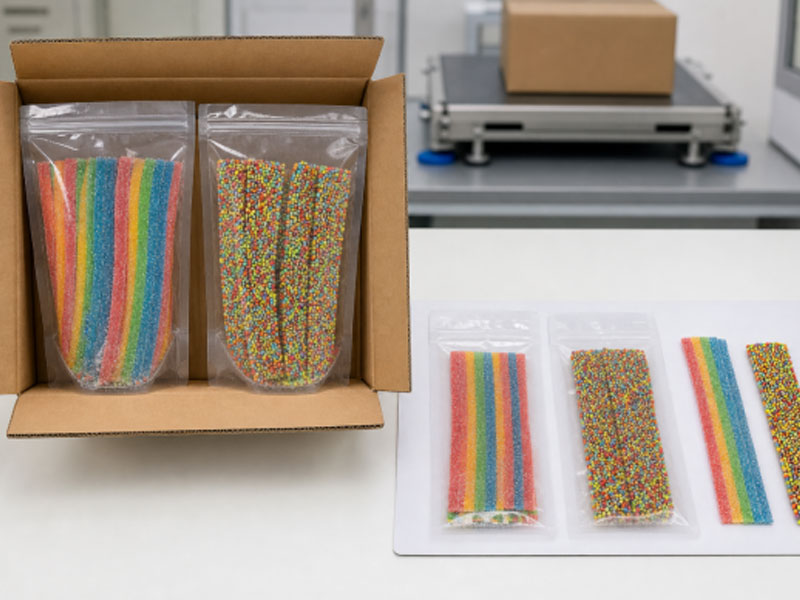
A crunchy-bead sour belt adds small, colorful candy beads to the surface. This produces a more layered eating sequence:
- The consumer first feels the crisp bead coating.
- Sour and sweet flavors develop together.
- The chewy belt becomes the main texture.
- The colorful coating remains a visible part of the experience.
The difference is not simply decorative. It affects product positioning, production control, packaging and the way buyers present the product to consumers.
| Buying factor | Crunchy-bead belt | Traditional belt |
|---|---|---|
| Product shape | Flat candy strip | Flat candy strip |
| Outer coating | Colorful crunchy beads | Fine sugar and sour powder |
| Main texture | Crunchy followed by chewy | Primarily chewy |
| Consumer familiarity | Emerging or novelty format | Highly familiar |
| Shelf differentiation | High | Medium |
| Packaging complexity | Relatively higher | Lower |
| Quality focus | Bead adhesion and coverage | Sugar coverage and moisture |
| Potential positioning | Differentiated or premium | Mainstream or value |
| Best initial role | Innovation or test SKU | Core or volume SKU |
Which Product Offers Better Shelf Differentiation?
1. Crunchy-bead sour belts
The bead coating creates a highly textured surface that is visibly different from conventional sour strips. This makes the format suitable for new-product displays, novelty-candy assortments, seasonal color programs, social-media content and private-label ranges seeking a recognizable identity.
Strong visibility does not guarantee strong sell-through. Buyers should still test pack design, retail price and consumer acceptance.
2. Traditional sour belts
Traditional sour belts compete through recognizable flavors, colors, pack sizes and value. Their advantage is familiarity: consumers generally understand the product without additional explanation.
- Core sour-candy assortments
- Price-sensitive retail programs
- High-volume distribution
- Pick-and-mix displays
- Markets where novelty candy requires more education
How Do the Eating Experiences Compare?
| Sensory stage | Crunchy-bead belt | Traditional belt |
|---|---|---|
| First bite | Crisp and textured | Soft or lightly granular |
| Main texture | Crunchy-to-chewy contrast | Consistent chew |
| Sour delivery | Can be layered across coating and belt | Usually immediate from surface crystals |
| Eating style | Bite, tear or share | Bite, tear or roll |
| Visual experience | Multicolored and highly textured | Striped or single-color surface |
Which Format Is Better for Supermarkets?
A traditional sour belt may be better suited to a permanent core range because it is familiar, easy to categorize and suitable for multiple price levels.
- New-product launches
- Limited-edition programs
- Seasonal displays
- Premium novelty-candy sections
- Retailer-exclusive flavors or colors
- Private-label innovation ranges
Before listing, supermarket buyers will normally need clear consumer-unit, display-case and pallet information. Packaging should be easy to stock, stable during transport and consistent with the retailer’s shelf-ready packaging requirements.
Which Format Is Better for Convenience Stores?
Convenience stores operate differently because shelf space is limited and purchasing decisions happen quickly.
A product has only a short time to communicate why it deserves attention.
This gives crunchy-bead sour belts an advantage when the coating is clearly visible through the package or shown strongly in the graphics.
A compact single-serve pouch can communicate both color and texture without requiring a large display.
Traditional belts, however, may still perform better when the target price is extremely important.
If the buyer’s priority is a familiar product at a competitive impulse-buy price, additional coating complexity may not add enough value.
The correct decision depends on whether the convenience-store program is driven primarily by price and familiarity or by novelty and visual impact.
Which Product Is Better for Importers and Distributors?
1. Traditional sour belt considerations
- Established category terminology
- Easier consumer understanding
- Potentially simpler coating control
- Broad suitability across retail and bulk channels
- Strong price competition and commodity risk
2. Crunchy-bead sour belt considerations
- Clearer visual differentiation
- Stronger texture-based positioning
- More private-label customization opportunities
- More coating variables to control
- Potential need for stronger packaging protection
The correct comparison should include landed cost, saleable yield, damaged-product risk, shelf life at arrival and expected inventory turnover.
What About Private Label?
Both formats can work well for private-label programs, but they offer different kinds of differentiation.
Traditional sour belts are usually customized through:
- Flavor
- Sourness
- Belt color
- Rainbow patterns
- Dimensions
- Package size
- Branding
Crunchy-bead belts add another layer of possible development through bead color, coating appearance and the contrast between the belt and outer layer.
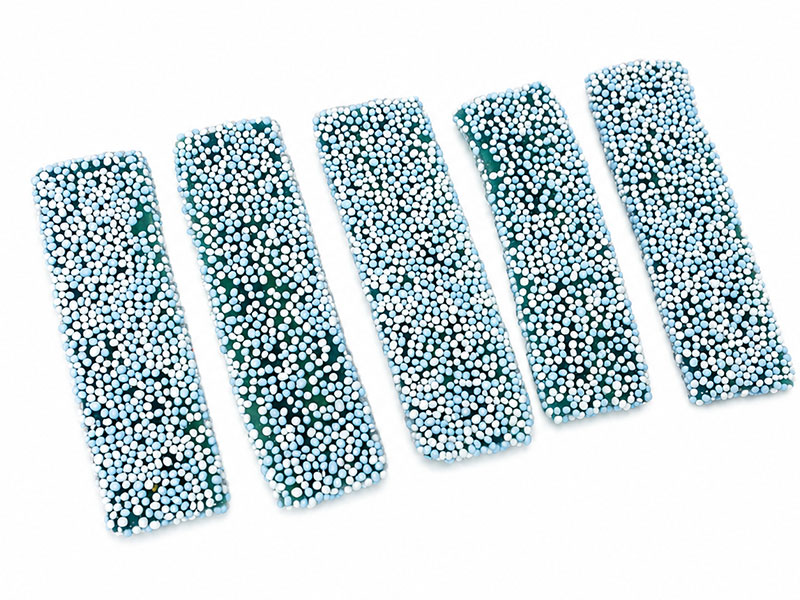
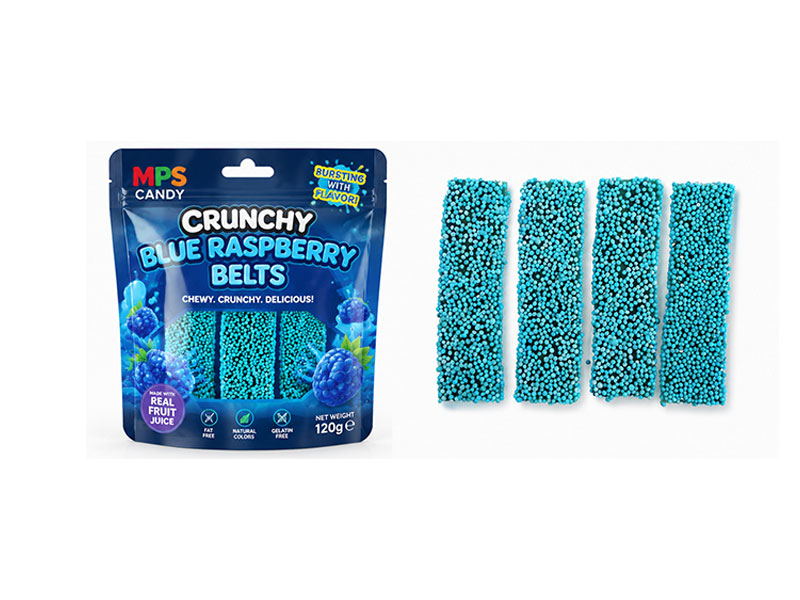
For example, a brand could combine a blue raspberry belt with blue and white beads, develop a red-and-green seasonal version or create a multicolor coating for a rainbow range.
This gives buyers more room to create a recognizable product identity.
However, additional customization also means additional production considerations. For brands requiring more customized shapes, flavors or packaging structures, OEM and ODM development may provide a more suitable route.
The best private-label concept is not necessarily the one with the greatest number of colors or variations. It is the one where the product, packaging, retail price and intended order volume make sense together.
Packaging Requirements Are Not Exactly the Same
Traditional sour belts already require good protection against moisture, sticking and deformation.
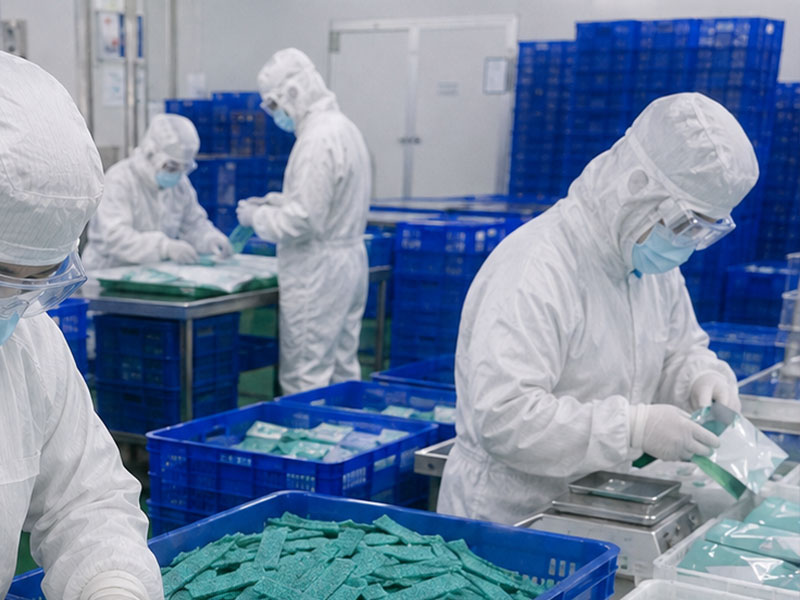
Crunchy-bead products add another concern: the coating must remain attached and reasonably crisp.
During production, packing and transportation, the product experiences repeated movement and pressure.
If the package allows excessive movement, more beads may loosen from the surface.
If moisture protection is insufficient, the crunchy coating may gradually soften.
This means packaging should be evaluated with the actual finished product rather than selected only according to appearance.
A pouch that looks attractive on screen may not necessarily provide the best protection during long-distance shipping.
For import buyers, this becomes especially important when products are transported through hot or humid environments.

Think in Terms of Product Roles, Not Just Products
The most useful way to compare these two formats is to ask what role each product should play in the assortment.
Choose a traditional sour belt when the priority is:
familiarity, broad consumer acceptance, mainstream pricing and high-volume distribution.
Choose a crunchy-bead sour belt when the priority is:
visual differentiation, textural innovation, novelty positioning and stronger private-label identity.
They can also complement each other.
A distributor may use traditional sour belts as its core volume products while offering crunchy-bead versions to customers looking for something newer.
A private-label brand may launch with a familiar belt and later introduce the crunchy version as a line extension.
A supermarket may use one in the permanent assortment and the other for seasonal or innovation displays.
In this context, the real question is not: Which sour belt is better?
It is: Which sour belt performs the job your market needs it to perform?
Frequently Asked Questions
1. Are crunchy-bead sour belts the same as regular sour belts?
No. Both use a chewy belt base, but traditional sour belts are normally coated with fine sugar or sour crystals, while crunchy-bead belts use larger crisp candy particles that create a stronger textural contrast.
2. Are crunchy-bead sour belts better for premium positioning?
They can support more differentiated or premium positioning because of their stronger visual and textural identity, but final positioning still depends on packaging, brand strategy, retail price and market response.
3. Which format is easier for consumers to understand?
Traditional sour belts are more familiar. Crunchy-bead belts may require a short product message, although “crunchy outside, chewy inside” is relatively easy for consumers to understand.
4. Which product is better for private label?
Both are suitable. Traditional belts offer straightforward flavor, color and packaging customization, while crunchy-bead versions add more possibilities through coating colors and texture positioning.
5. Do crunchy-bead belts require different packaging?
They may require greater attention to moisture protection, coating loss and product movement during transportation. Packaging should be evaluated using the actual finished product.
6. Which product should a new buyer choose?
If familiarity, price and volume are the main priorities, a traditional sour belt may be the more straightforward starting point. If differentiation and texture are more important, a crunchy-bead belt may be worth evaluating.
Which Sour Belt Fits Your Market?
Traditional sour belts remain strong because consumers already know and understand them.
Crunchy-bead sour belts do something different: they take that familiar format and give it a more visible and textural reason to stand out.
For buyers, the right decision should come from the target consumer, sales channel, price position and role within the wider candy range.
MPS Candy is a China-based candy manufacturer and exporter supporting bulk, private-label and OEM/ODM sour candy production for international B2B buyers.