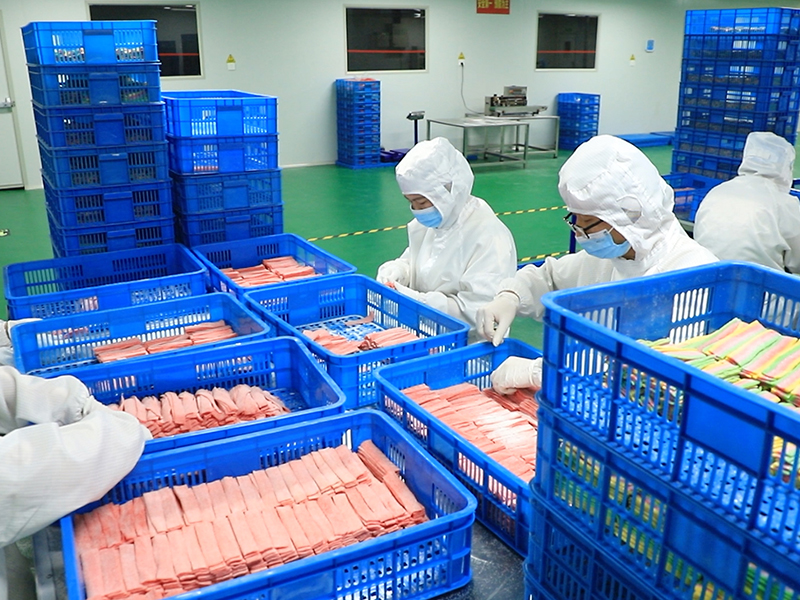
Marshmallows are known for their soft, fluffy texture, but achieving that texture consistently in commercial production involves more than simply whipping a sugar mixture. The internal structure of a marshmallow is formed by air distributed throughout a stabilized sugar system. How much air is incorporated, how evenly it is distributed and how well the structure holds together all influence the final product.
Two marshmallows may use similar ingredients and have the same flavor, yet feel noticeably different when eaten. One may be light and resilient, while another feels dense, firm or slightly sticky. These differences can affect not only the consumer experience but also piece weight, product dimensions, packaging efficiency and consistency between production batches.
For candy manufacturers and B2B buyers, the objective is not to incorporate as much air as possible. It is to establish a suitable foam structure that delivers the intended texture while remaining stable during forming, packing, storage and international distribution.
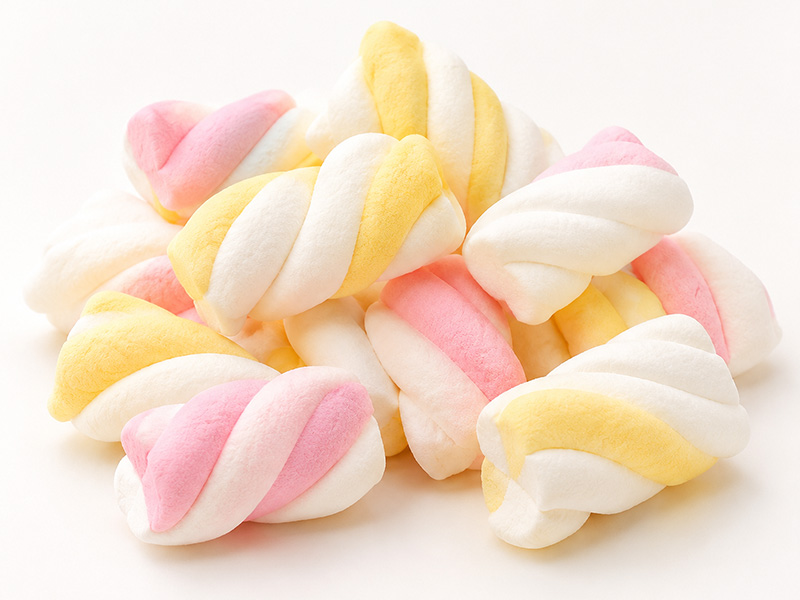
Marshmallow Is a Stabilized Foam, Not Simply Whipped Sugar
The characteristic texture of marshmallow comes from a foam structure in which small air cells are distributed throughout a continuous sugar-based phase. In conventional formulations, gelatin commonly serves two important functions: it helps incorporate and stabilize air during whipping, and it contributes to the gel network that gives the finished product its structure.
During aeration, the mixture expands as air is introduced. The stabilizing system helps prevent the bubbles from collapsing before the marshmallow has been formed and allowed to set. Once the structure is established, the product can retain its expanded volume while providing the soft, elastic bite associated with marshmallows.
This explains why marshmallow production requires a different approach from hard candy or ordinary gummy candy. The manufacturer is not simply controlling sweetness, moisture or shape; the internal foam structure is itself a major part of the product specification.
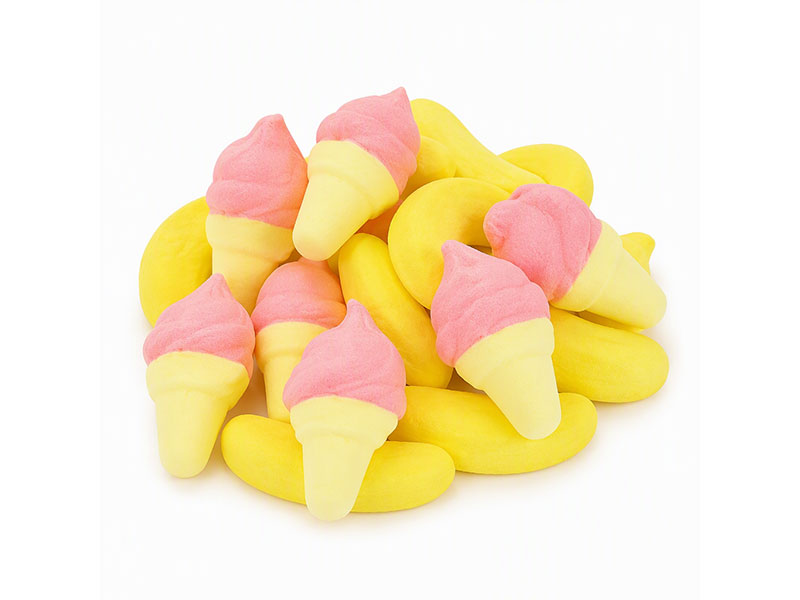
What Does Marshmallow Density Have to Do with Texture?
Density describes the mass of a product relative to its volume. In marshmallow production, it is closely connected to aeration because incorporating more air generally increases volume without adding an equivalent amount of mass. As a result, a more highly aerated mixture usually has a lower density than a less aerated mixture made with a comparable formulation.
However, density should not be treated as a complete measure of softness. A low-density marshmallow is not automatically softer, and a higher-density product is not necessarily inferior. The final texture also depends on the size and distribution of the air cells, the properties of the stabilizing system and the way the foam develops during setting.
For commercial production, density is therefore useful as a process indicator, but it needs to be considered alongside the actual physical characteristics of the finished candy.

More Air Does Not Always Produce a Better Marshmallow
It is tempting to assume that increasing aeration will always make marshmallows lighter and softer. In practice, the relationship is more complicated. If the air content is too low, the product may feel unnecessarily dense and lack the characteristic lightness expected from marshmallow. If aeration is excessive or poorly controlled, the foam may become less uniform, affecting the finished product’s appearance, structure and consistency.
The target is a balanced foam in which the air cells are sufficiently stable and evenly distributed. A suitable structure allows the marshmallow to maintain its intended volume and texture without becoming difficult to form or handle during subsequent production stages.
| Production condition | Possible effect on the marshmallow | Commercial consideration |
|---|---|---|
| Insufficient aeration | Denser structure and reduced volume | The finished product may feel heavier and less fluffy |
| Controlled aeration | More uniform foam structure and predictable volume | Supports consistent texture, dimensions and piece weight |
| Excessive or uneven aeration | Irregular air-cell distribution and potentially unstable structure | May create differences in appearance, texture and production consistency |
| Inconsistent aeration between batches | Changes in density and product dimensions | Can affect pack appearance and repeat-order consistency |
The appropriate target depends on the intended product. A classic soft marshmallow, a mini marshmallow used as a topping and a larger novelty piece may have different requirements. The correct structure should be selected according to the product’s intended use rather than a general preference for maximum expansion.
Air Bubble Distribution Matters as Much as Air Quantity
The amount of air incorporated is only one part of the equation. The size and distribution of individual air cells also influence how a marshmallow feels when compressed and chewed.
A foam with a relatively uniform internal structure is generally easier to control than one containing a mixture of very large and very small bubbles. Uneven air-cell distribution can create local differences in firmness and resilience, even when the overall density appears acceptable. This is one reason why measuring density alone may not fully explain why two production samples feel different.
For manufacturers, the challenge is to achieve a repeatable foam structure throughout the production process. For buyers, this means evaluating the actual eating experience rather than judging a marshmallow only by its apparent size or volume.
A product that looks equally fluffy from the outside may still have a different internal structure. Physical samples are particularly useful when softness, elasticity and mouthfeel are important characteristics of the finished product.
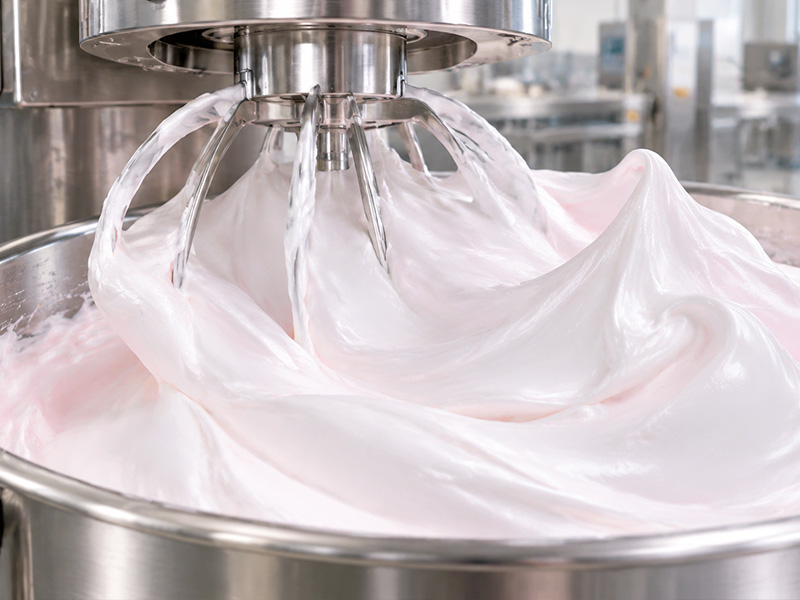
How Ingredients Influence Aeration and Firmness
The formulation plays an important role in determining how easily air can be incorporated and how well the resulting foam remains stable. In conventional marshmallow production, gelatin contributes both foaming functionality and structural support. Its type and concentration can influence the firmness and elastic properties of the finished product.
Sugar, glucose syrup and water also affect the system. The balance of dissolved solids and moisture influences the viscosity of the mixture, which in turn affects how air can be introduced and retained. Changes to one ingredient may therefore influence more than sweetness or flavor; they can also change the way the foam develops and sets.
This is why adjusting a marshmallow formula requires an understanding of how its components interact. Simply increasing the amount of a stabilizing ingredient to make the product firmer, for example, may also change its whipping behavior and final texture. The formulation needs to be evaluated as a complete system.
For private label and OEM projects, the desired texture should be established before making extensive formulation changes. A clear target helps the manufacturer evaluate which adjustments are technically appropriate without unnecessarily complicating the production process.
Why Aeration Control Becomes More Important at Commercial Scale
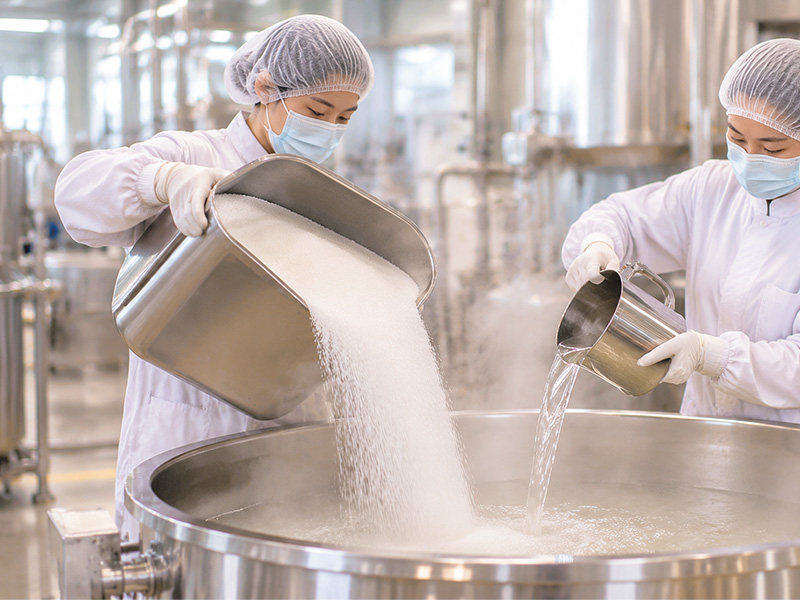
A small development batch and a commercial production run do not necessarily produce the same foam structure under identical ingredient proportions. Different mixing systems, batch sizes, air-input conditions and processing speeds can change the way air enters the mixture and how the bubbles develop.
Commercial equipment may use continuous aeration systems in which air is introduced and dispersed through the moving product. The resulting foam structure can differ from that produced by a smaller batch mixer. This means that a successful development sample is not, by itself, proof that the same texture will automatically be reproduced at a much larger output.
At production scale, consistency depends on controlling the process rather than relying on the recipe alone. Air input, mixture properties, temperature, processing conditions and product flow all need to work together. If one of these factors changes significantly, the resulting foam may also change.
For manufacturers, the important task is to establish production conditions that can be maintained across the intended run. For buyers, this explains why commercial sample approval should consider not only taste and appearance but also whether the product can be reproduced consistently using the intended manufacturing process.

Density Also Affects Piece Weight and Packaging Efficiency
Aeration has a direct commercial consequence because it changes the relationship between product volume and weight. For marshmallows with comparable external dimensions, differences in density can result in differences in individual piece weight. This may influence how many pieces are needed to reach a specified net weight and how the finished product fills a retail package.
The impact becomes more noticeable when a product is sold in bags, jars or mixed assortments. A marshmallow that occupies more volume at a given weight may require a different package size or create a different visual fill level. If the density or piece dimensions vary between batches, the appearance of the finished retail pack may also become less consistent.
This is why product development should consider density together with piece dimensions, target weight and packaging format. A marshmallow that performs well in a sample bag should also be evaluated in the intended commercial pack before the specifications are finalized.

Forming and Cutting Require a Stable Foam Structure
After aeration, the marshmallow mass needs to retain enough structure for the selected forming method. For extruded products, the foam must pass through the shaping system and maintain a reasonably consistent profile before being cut into individual pieces.
If the structure changes during processing, the finished pieces may show differences in dimensions, shape definition or surface appearance. This can affect the uniformity of mixed assortments and the way the product fills its packaging.
The relationship between aeration and forming is particularly important when developing different piece sizes or profiles. A texture that works for one format may not automatically be suitable for another. The product’s internal structure, forming requirements and final dimensions should therefore be considered together during commercial development.
Conditioning and Moisture Control Help Preserve the Finished Texture
Forming does not necessarily mean that the marshmallow has reached its final stable condition. The product may require a conditioning period before packing so that its structure and handling characteristics become suitable for the intended format.
Moisture also remains important after production. Marshmallows can gradually lose moisture during storage, and this can contribute to hardening and changes in elasticity. The rate and extent of these changes depend on the formulation, product structure and storage environment.
Packaging therefore needs to provide suitable protection against external moisture conditions. For international supply, the manufacturer should consider the product’s moisture sensitivity alongside the packaging material, sealing performance and expected distribution conditions. A suitable foam structure at the factory is only part of the requirement; the product also needs to maintain acceptable quality throughout storage and transportation.
What Should B2B Buyers Evaluate When Sourcing Marshmallows?
Buyers do not normally need to specify the exact amount of air incorporated into a marshmallow unless they already have a defined technical standard. For most commercial projects, it is more practical to describe the intended eating experience and evaluate whether the finished product meets that target.
Softness, elasticity and piece weight should be considered together. A very light product may not be suitable for every application, while a firmer marshmallow may be preferable when the product needs to maintain its shape in a particular retail or food-use format. The intended application should guide the specification.
| What to evaluate | What it tells the buyer | Why it matters |
|---|---|---|
| Softness and bite | Whether the product delivers the intended eating experience | Influences consumer acceptance and product positioning |
| Elasticity | How the marshmallow responds when pressed or chewed | Helps assess the structure of the finished foam |
| Piece weight and dimensions | Whether the product matches the intended specification | Affects net weight, piece count and packaging |
| Shape consistency | Whether individual pieces look uniform | Important for retail presentation and pack appearance |
| Surface condition and stickiness | Whether the product can be handled and packed properly | Influences packing performance and storage |
| Texture after storage | Whether the product maintains acceptable softness | Important for shelf life and export distribution |
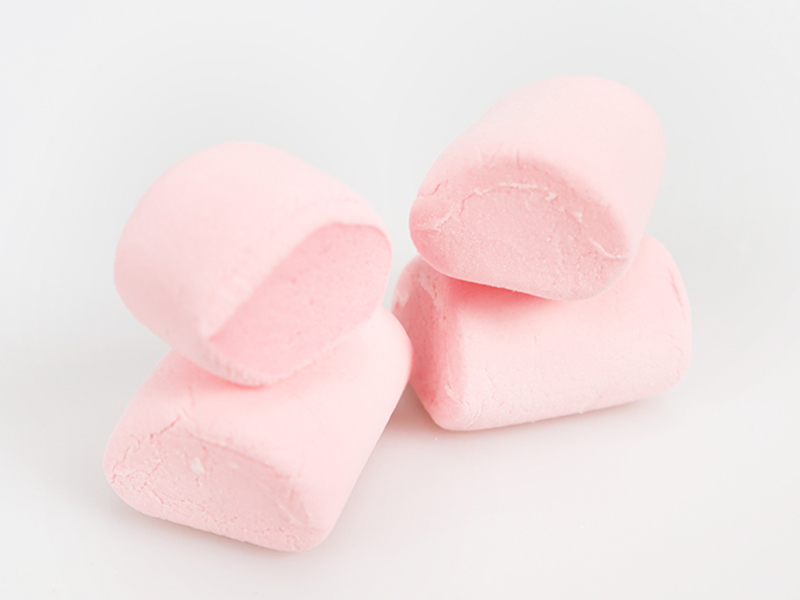
A useful product brief should also identify the intended market, retail or food-service application, preferred marshmallow format, approximate piece size, target net weight and packaging structure. If the buyer has an existing product as a reference, a physical sample can help communicate the desired texture more accurately than a written description alone.
Why the Approved Sample Must Represent the Commercial Product
A development sample is useful only when it provides a realistic reference for the product that will eventually be manufactured. If the sample is noticeably lighter, softer or more elastic than the commercial product, the buyer may find that the finished order does not match the original expectation even when the flavor and appearance are broadly similar.
This is particularly relevant to marshmallows because the foam structure contributes so much to the eating experience. The approved reference should therefore represent the intended texture, dimensions, approximate piece weight and overall product characteristics. Any meaningful adjustment required for commercial production should be evaluated before the specifications are finalized.
For repeat orders, maintaining the same product direction is just as important as achieving it in the first production run. Clear specifications and consistent evaluation make it easier to manage differences between batches and reduce misunderstandings when the product is reordered.

Frequently Asked Questions
1. Does more air always make marshmallows softer?
No. More air generally reduces density and increases product volume, but softness also depends on air-cell size and distribution, the formulation and the strength of the stabilizing structure. Excessive or uneven aeration may produce an inconsistent product rather than a better texture.
2. What is marshmallow density?
Density is the mass of a product relative to its volume. In marshmallow production, it is closely related to the amount of air incorporated into the foam. It is a useful process indicator, but it should be evaluated together with firmness, elasticity and other finished-product characteristics.
3. Why do marshmallows become hard during storage?
Moisture loss is one important reason marshmallows become harder over time. Changes in the sugar structure and gel network may also contribute. Formulation, packaging and storage conditions all influence how well the product maintains its original texture.
4. Does marshmallow density affect piece weight?
Yes. For products with comparable external dimensions, differences in density can result in differences in individual piece weight. This can influence the number of pieces required to reach a target net weight and the appearance of the finished retail package.
5. Can the same marshmallow formula produce different textures on different production lines?
Yes. Equipment, batch size, aeration method and processing conditions can influence the resulting foam structure. A formula that performs well in a small development batch may need process evaluation before it can be reproduced consistently on commercial equipment.
6. Can marshmallow softness and texture be customized for private label projects?
The target texture, piece size and product format can be evaluated as part of an OEM or private label project. The final options depend on formulation, manufacturing feasibility and the intended commercial application. A physical reference sample is useful when a specific softness or bite is required.
7. Is marshmallow suitable for export and long-distance distribution?
Yes, suitable marshmallow products can be supplied for international B2B programs. However, moisture protection, sealing performance, storage conditions and the finished product’s stability need to be considered when selecting the packaging and planning export distribution.
Consistent Marshmallow Texture Starts with Controlled Production
The soft texture of marshmallow is the result of a carefully developed foam structure, not simply the amount of air added during whipping. Density, bubble distribution, formulation and processing conditions all contribute to the final product, while forming, conditioning and packaging help preserve its characteristics after production.
For B2B buyers, understanding this relationship makes it easier to evaluate samples, define product specifications and select a suitable marshmallow format for the intended market. The most commercially useful product is not necessarily the lightest or the softest one, but the one that delivers the right eating experience and can be manufactured consistently at the required volume.
MPS Candy is a China-based candy manufacturer and exporter supporting commercial marshmallow production, OEM/ODM development and private label programs for international brands, importers, distributors, wholesalers and retail buyers.
Developing a Marshmallow Product for Your Market?
Share your target market, preferred marshmallow format, desired texture, approximate piece size, packaging requirements and expected commercial quantity. MPS can evaluate the product direction and discuss a suitable manufacturing solution for your project.