A private label candy project does not become distinctive simply because a new logo appears on the package.
For crunchy candy-coated gummies, the stronger opportunity is to turn one recognizable product idea into something that consumers can begin to associate with a particular brand.
a crisp first bite followed by a soft, chewy gummy center.
From there, a brand can decide how much of the product should remain consistent and where meaningful differences should appear.
The shape may change from a ring to a star or worm. Flavors may separate different SKUs. The coating can create a recognizable visual language. Packaging can reinforce the texture instead of simply covering it.
The challenge is not finding the maximum number of things that can be customized.
It is deciding which changes actually make the product stronger commercially.
That is the difference between producing a private label gummy and building a private label gummy range.
Start with the Reason the Product Should Exist
Before choosing colors, flavors or packaging, a buyer should first understand what role the crunchy gummy is supposed to play.
A company that already sells traditional gummies may want a more innovative extension.
An importer may need something visually different from conventional sugar-coated gummies.
A retail buyer may want a product that feels new without moving too far away from an established confectionery category.
Those are different objectives, even if the final products all use crunchy coatings.
If the only goal is to add another inexpensive fruit gummy, a crunchy coating may introduce more complexity than value.
If the goal is to create a product with a more obvious sensory difference, the coating becomes part of the reason the product exists.
This is where private label development should begin.
Not with: What can the factory customize?
But with: What should the consumer notice about this product first?
Private Label Does Not Mean Everything Needs to Be Custom
There is a common assumption that a more customized product is automatically a better private label product.
That is not necessarily true.
A project can quickly become complicated if the buyer requests a new formula, custom mold, several flavors, several coating combinations and a completely new package at the same time.
Every one of those ideas may be technically possible.
But they also create more variables before the product has proven itself in the market.
A better development route depends on the commercial objective.
| Development Route | Typical Approach | Complexity | When It Makes Sense |
|---|---|---|---|
| Existing product + private label packaging | Proven product structure with buyer's branding | Lower | Faster market entry |
| Existing structure + customized flavor, color or coating | Core product stays stable while visible characteristics change | Medium | Stronger brand differentiation |
| Custom mold or deeper product development | Shape or product structure changes more substantially | Higher | Exclusive concepts and larger long-term programs |
This is why a private label project should not be judged by how many specifications have been changed.
A product using an existing ring mold can still look and feel highly differentiated if the flavor, coating, color and packaging work together well.
Why the Ring Often Makes Sense as the First SKU
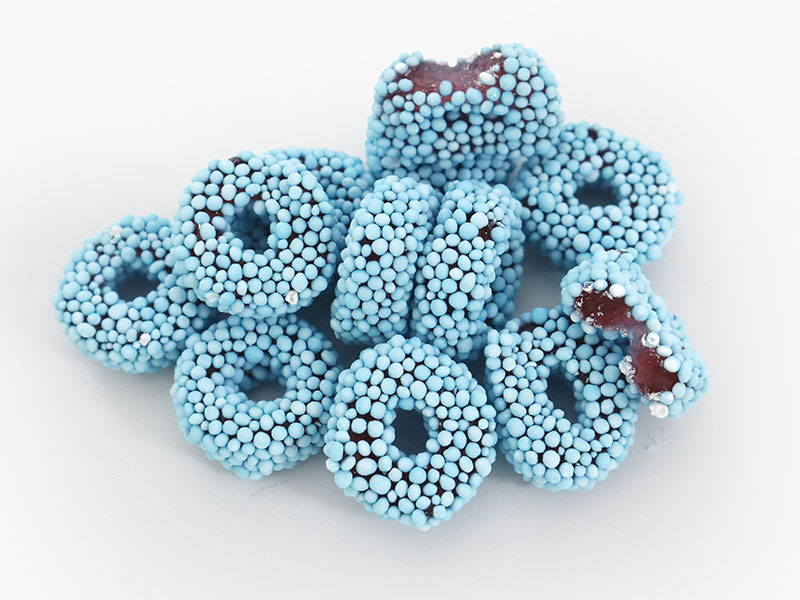
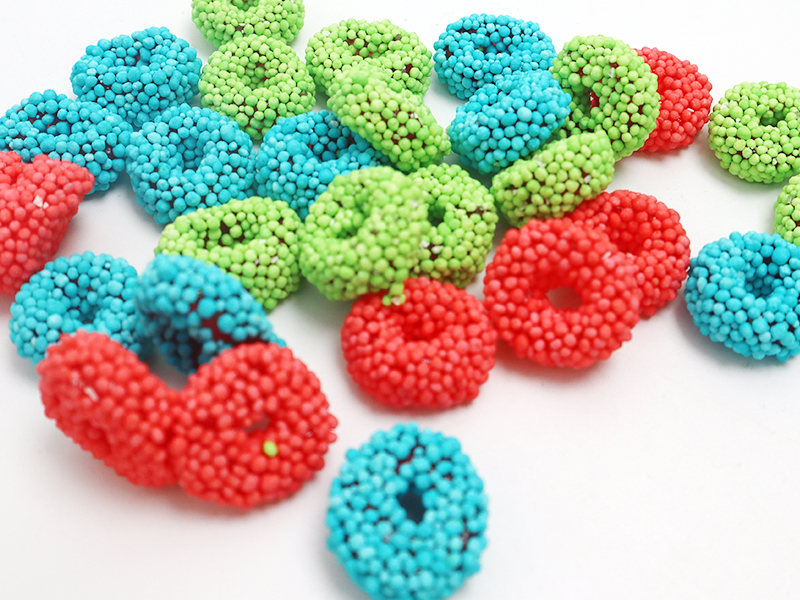
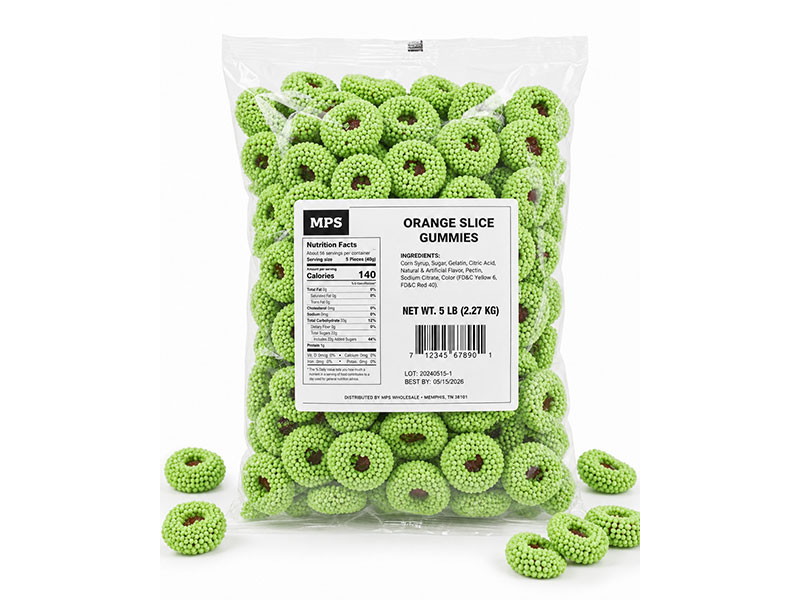
Crunchy gummy rings are a practical starting point because the consumer already understands the shape.
Gummy rings are familiar.
The buyer does not have to explain what type of candy is inside the package before introducing the new element.
The innovation becomes the texture.
A consumer sees a familiar ring, bites into it and discovers that the surface is crisp before the gummy center becomes chewy.
That balance between familiarity and novelty is useful for a first product.
The shape also works visually.
The coating remains visible around the outer surface and around the open center, giving the product a textured appearance from multiple angles.
In clear packaging or close-up photography, this can make the crunchy element easy to communicate.
For a brand entering the category for the first time, the ring can therefore become the product that teaches consumers what the range is about.
Stars Can Change the Personality Without Changing the Core Idea
Once the crunchy texture is established, shape can be used to create a different personality.
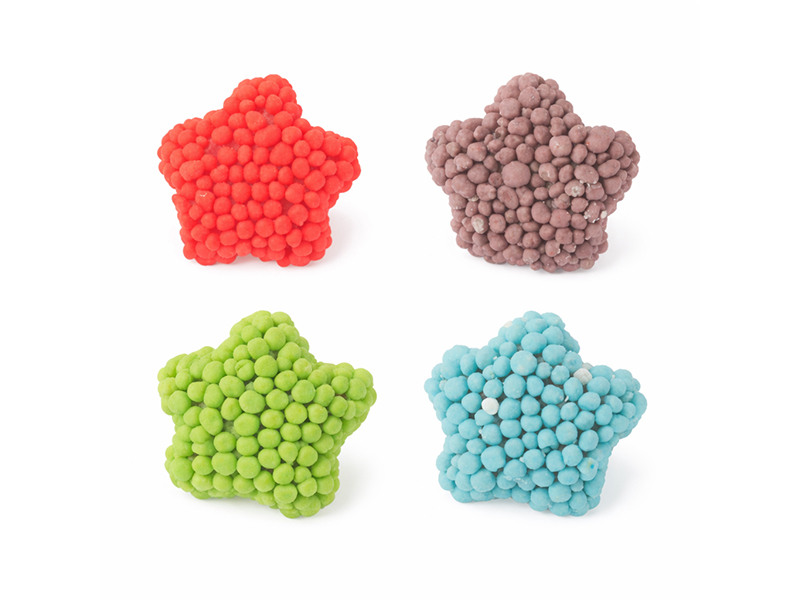
A star feels more decorative than a ring.
Its points and edges make the candy look more intentionally designed and can move it toward novelty, themed or seasonal positioning.
The important point is that the product does not need an entirely new concept.
The consumer can still recognize the same basic promise:
crunchy outside, chewy inside.
The shape changes the mood.
A brightly colored star may work as part of a playful mixed-fruit range.
A more controlled palette could move the same shape into a seasonal collection.
This gives private label buyers a way to extend a product family without redesigning the entire candy experience each time.
Worms Create a Different Way to Eat the Product
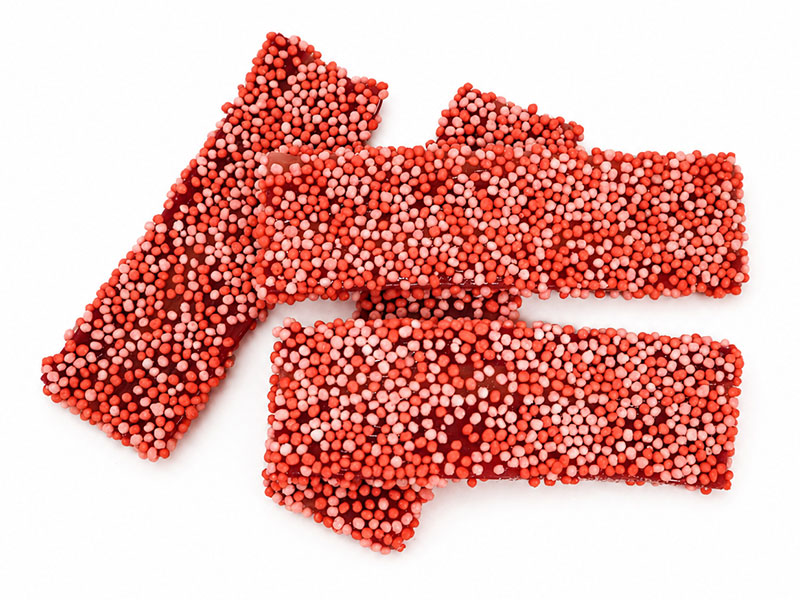
Flat crunchy gummy worms create another kind of distinction.
They are longer than rings or stars and naturally encourage a more interactive eating experience.
A small ring may disappear in one or two bites.
A longer worm lets the consumer bite through the crunchy coating several times before the piece is finished.
That means the texture contrast is repeated during the eating experience.
The larger visible surface can also make the coating easier to show in photography and transparent packaging.
Several long pieces layered inside a pouch create a very different visual presentation from compact gummy shapes.
For brands using energetic, playful or novelty positioning, this format can therefore serve a different role from the core ring SKU.
A Custom Mold Should Have a Commercial Purpose
A proprietary gummy shape can create exclusivity, but exclusivity alone is not always enough reason to develop a new mold.
The strongest custom shapes usually have a clear connection with the brand or retail concept.
A recognizable symbol, mascot-inspired form, seasonal object or retailer-exclusive design may justify the additional development.
A slightly modified ring that consumers barely notice may not.
There is also a manufacturing question that drawings do not always reveal.
Once crunchy particles are added, fine details can become less visible.
Small grooves can fill with coating.
Very thin areas may be difficult to produce consistently.
Sharp details may appear softer after coating.
For crunchy gummies, a custom shape must therefore be evaluated after the coating is considered, not only as an uncoated gummy model.
The finished candy needs to remain recognizable after molding, coating, packing and transportation.
Flavor Is Where Private Label Ranges Often Become Too Large
Flavor expansion feels easy because every additional flavor looks like another sales opportunity.
A buyer may start with strawberry and quickly add watermelon, grape, green apple, blue raspberry, mango, peach and mixed fruit.
On a presentation board, this looks like a strong range.
In production, each flavor may have its own MOQ.
That changes the commercial calculation.
Three focused flavors may create enough variety for a first launch without spreading the initial order across too many production combinations.
The brand can then learn from actual sales.
If blue raspberry performs particularly well, the next order can grow.
If consumers begin asking for watermelon, it can become a meaningful line extension.
This creates a healthier development cycle than launching every possible flavor before the product has reached the market.
Color Can Become Part of the Product Identity
Flavor and color often work together naturally.
Strawberry is commonly associated with pink or red.
Green apple is expected to be green.
Grape usually appears purple.
These relationships help consumers understand the product quickly.
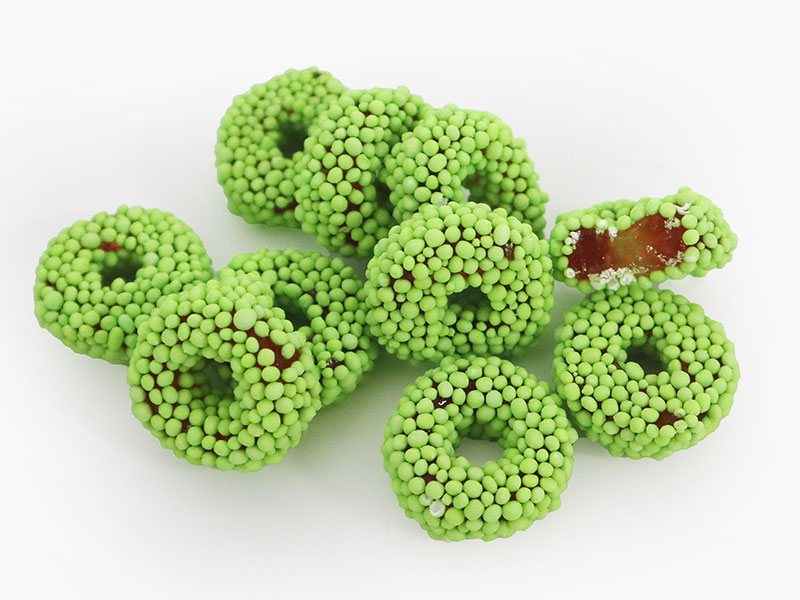
Crunchy gummies create another possibility because there are two visible color layers:
the gummy center and the coating.
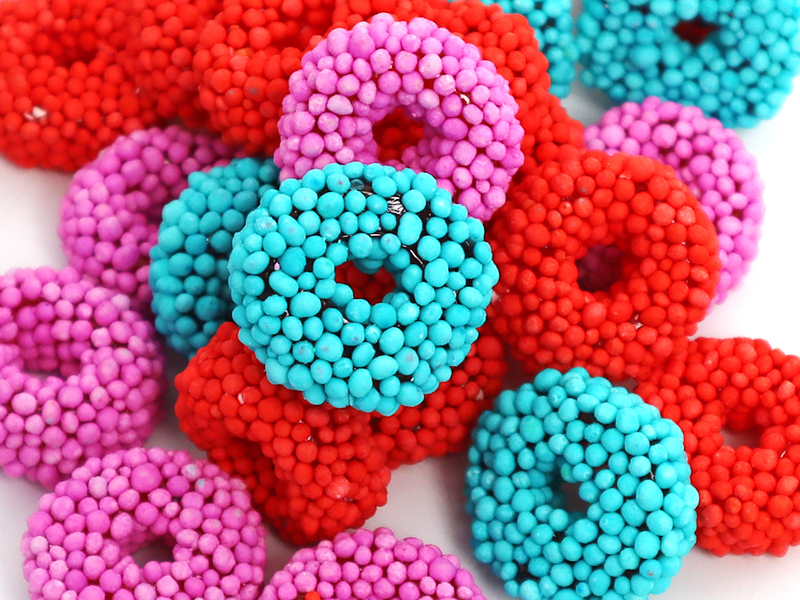
A pink center with pink-and-white particles looks coordinated.
The same pink center with a multicolor coating feels more playful.
A dark center beneath a bright coating creates stronger contrast.
This means the product itself can carry part of the visual branding before the packaging design is even considered.
For a private label range, that can be powerful.
Different SKUs can feel related through the coating style while still using different center colors or flavors.
The Coating Is Part of the Product, Not a Decoration Added at the End
With ordinary gummies, most of the visual identity comes from the gummy body.
Crunchy gummies divide that role between the inside and outside.
The coating is what consumers see first.
It is also what they feel first.
Particle size changes the visual texture.
Coverage affects how strongly the product communicates crunch.
Color combinations influence whether the candy feels playful, coordinated or highly contrasting.
The coating also has to work with the gummy underneath.
Too little may not create enough sensory difference.
Too much may overpower the chewy center or leave more loose particles inside the pouch.
The objective is not maximum coating.
It is the right balance between the two textures.
That balance is one of the most important parts of developing a recognizable crunchy gummy product.

More Customization Is Not Always More Differentiation
Imagine two product briefs.
The first requests a new gummy formula, new mold, five coating combinations, six flavors and completely custom packaging.
The second starts with an established crunchy ring but develops three carefully selected flavors, a consistent coating style and packaging designed specifically around the texture.
The first project is more customized.
The second may still create the stronger retail product.
Consumers do not see development complexity.
They see the finished experience.
If a product already has a clear reason to buy, adding more custom elements does not automatically make that reason stronger.
Good private label development therefore involves restraint.
The buyer and manufacturer should identify which changes consumers will actually notice and which changes mainly add time, MOQ or cost.
Packaging Should Make the Texture Easy to Understand
A crunchy gummy has a useful advantage: its difference can be shown visually.
Packaging should make use of that.
If the product image is too small, the candy may simply look like another colorful gummy.
A closer image can reveal the coating.
A cross-section can show that the center is still soft and chewy.
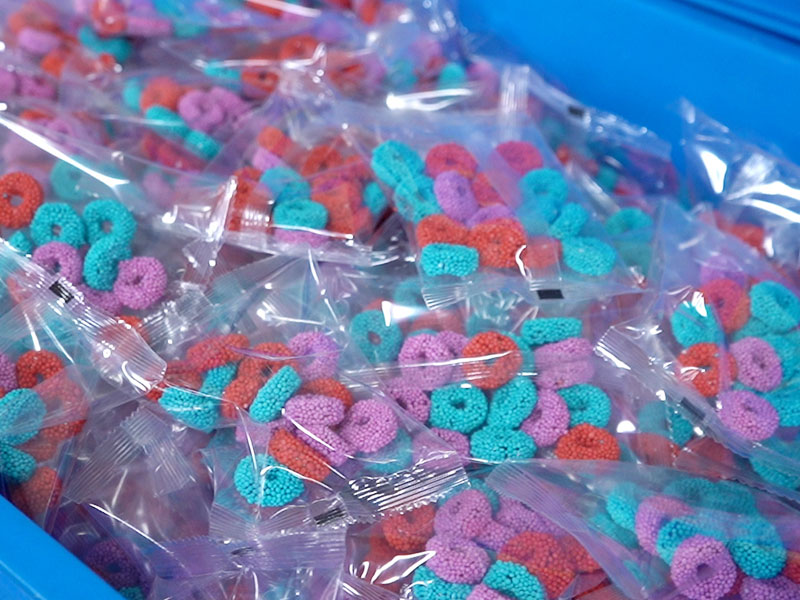
A transparent window may allow the actual product to communicate the texture directly.
The message does not need to become complicated.
A phrase such as:
Crunchy Outside. Chewy Inside.
can explain the core experience in very little space.
For e-commerce, detailed photography becomes even more important because customers cannot touch the product before buying it.
The packaging, photography and product description should all tell the same story.
Good Packaging Also Has to Preserve the Product
Visual communication is only half of the packaging job.
The other half is protection.
Crunchy candy-coated gummies combine a relatively soft gummy center with a drier exterior layer.
That contrast is part of the appeal, but it can also be affected by moisture, heat and storage conditions.
If the coating gradually softens, the product loses part of what makes it different.
If the gummy becomes too firm, the intended contrast also changes.
For international supply, packaging therefore needs to be evaluated together with shipping conditions.
The product may spend weeks in production, warehousing and transportation before it reaches the customer.
Gummies and other heat-sensitive confectionery generally require refrigerated transportation during international shipment to help protect product quality.
A visually attractive package is useful.
A visually attractive package that also helps preserve the intended texture is much more important.
Sampling Should Answer Specific Questions
Sampling works best when each round has a purpose.
Feedback such as:
Make it more premium.
is difficult to translate into a specific technical change.
More useful feedback would be:
Keep the center equally soft, but increase the coating slightly.
Or: Reduce the sweetness of the gummy while keeping the same sour coating.
Or: Make the blue coating darker so it matches the packaging direction.
This allows each sample round to answer a defined question.
The project moves forward instead of simply generating another variation.
For a product involving center texture, coating, flavor and color, specific feedback is especially important because changing one feature may affect the others.
The Physical Product Should Influence the Package
Packaging artwork is sometimes developed too early.
A designer begins with an assumed candy size.
Later, the physical sample arrives and the pouch no longer feels right.
Perhaps the pieces are larger than expected.
Perhaps fewer pieces fit into the target net weight.
Perhaps the coating makes the candy occupy more volume.
Perhaps the transparent window no longer frames the product well.
This is why candy development and packaging development should overlap.
The actual product influences package dimensions, product count, visual presentation and carton planning.
Once the candy structure is sufficiently stable, the final packaging can be built around what actually exists.
That reduces expensive redesign later.
Think About SKU Two While Developing SKU One
The first private label product should be able to succeed by itself.
But it should also leave room for growth.
A ring may become the core SKU.
A star may later introduce a themed range.
A worm can add a playful extension.
A custom shape may become worthwhile once the brand secures a larger retail program.
Flavor can grow in the same way.
The first launch may use three familiar fruit flavors.
A later collection could introduce tropical flavors or stronger sourness.
Seasonal variations can refresh the range without replacing the entire product platform.
This approach turns one product into the beginning of a system rather than an isolated launch.
How MOQ Affects the Range You Build
MOQ is important because it determines whether the planned assortment makes sense at commercial scale.
There is no single universal MOQ for every candy.
For many candy products, a useful general reference is approximately 2–4 metric tons per flavor, depending on the formula, shape, process and packaging.
Piece-counted, individually wrapped, molded or highly customized products may instead use MOQ calculations based on pieces, packaging quantity or production batch.
This means three flavors should not automatically be treated as one combined MOQ.
Each applicable flavor or product requirement needs to be evaluated separately.
Once those requirements are met, different qualifying flavors and MPS products can be combined in the same container. Shipments may also be consolidated with goods from the buyer’s other suppliers in China.
For international purchasing, full-container planning generally provides better freight efficiency.
This is another reason a focused product range can be commercially stronger than launching too many variations at once.

Private Label Can Be the Beginning of Deeper Development
A buyer does not need to make every product exclusive from the first order.
A project may begin with an existing crunchy ring, selected flavors and branded packaging.
Once the product has established demand, the next stage can go further.
The coating may change.
Another shape may be introduced.
A custom mold may eventually become justified.
The product formula itself may be developed more deeply.
This staged approach gives the brand real market information before each additional investment.
That often produces better decisions than trying to create the final version of an entire range before consumers have seen the first product.
Frequently Asked Questions
1. What are private label crunchy gummies?
Private label crunchy gummies are crunchy candy-coated gummy products manufactured for a buyer and sold under the buyer’s own brand. Depending on the project, the buyer may customize suitable flavors, colors, coating direction, assortment and retail packaging.
2. What crunchy gummy shapes are available?
Current MPS development includes rings, stars and flat gummy worms. Other shapes may be evaluated depending on the product concept, manufacturing feasibility and commercial requirements.
3. Do I need a custom mold for private label crunchy gummies?
No. Many private label projects can begin with an existing mold and create differentiation through flavor, color, coating and packaging. A custom mold makes more sense when the shape is important to the brand identity or retail program.
4. Can I customize the flavor and coating?
Yes. Suitable flavor, color and coating directions can be discussed according to the selected product and manufacturing feasibility. More complex customization may require additional sampling and development.
5. How many flavors should I launch?
There is no fixed number. A focused initial range is often easier to manage commercially because MOQ may apply separately to different flavors. Additional flavors can be introduced after the brand has more sales information.
6. What is the MOQ for private label crunchy gummies?
MOQ varies by product and packaging format. For many candy products, the typical MOQ is approximately 2–4 metric tons per flavor. Piece-counted, individually wrapped, molded or highly customized products may instead be calculated by pieces, packaging quantity or production batch.
Different qualifying flavors and MPS products can be combined in one container once their applicable MOQ requirements are met.
7. Can different flavors or products be combined in one container?
Yes. Each selected flavor or product must first meet its applicable MOQ, but different qualifying flavors and MPS products can then be combined in one container. The shipment may also be consolidated with goods from the buyer’s other suppliers in China.
8. Can I use my own branded packaging?
Yes. Private label projects can use buyer-approved branded packaging subject to the applicable printing, packaging and labeling requirements.
9. Are crunchy gummies suitable for supermarket and retail programs?
Yes. The format can be developed for retail pouches, jars, display boxes and other suitable formats according to the target market and sales channel.
10. Do crunchy gummies require refrigerated shipping?
Yes. Gummies, chocolate and other heat-sensitive products should be shipped in a reefer container for international transportation to help protect product quality.
11. What is the difference between private label and custom ODM development?
Private label normally begins with a more established product structure and focuses on selected product and branding changes. ODM or deeper custom development may involve more substantial changes such as a new product structure, new mold, new texture or other technical development.
12. What information should I provide to start a project?
A useful starting brief should explain the target market, preferred crunchy gummy shape, flavor direction, packaging format, expected commercial quantity and intended launch schedule. A reference product or visual concept can also help communicate the desired direction.
From One Crunchy Gummy to a Recognizable Product Range
A strong private label crunchy gummy should not feel like a generic product that simply received a new logo.
The product itself should contribute to the brand identity.
The shape gives it personality.
The flavor creates variation.
The color helps organize the range.
The coating defines much of the texture experience.
The packaging brings those elements together.
When these decisions reinforce one another, a single SKU can become the starting point for a much larger product family.
MPS Candy is a China-based candy manufacturer and exporter supporting private label crunchy gummies, OEM/ODM development and commercial B2B production for international brands, importers, distributors and retail buyers.